 111
111 2
2 3
3 4
4 5
5 6
6 7
7 8
8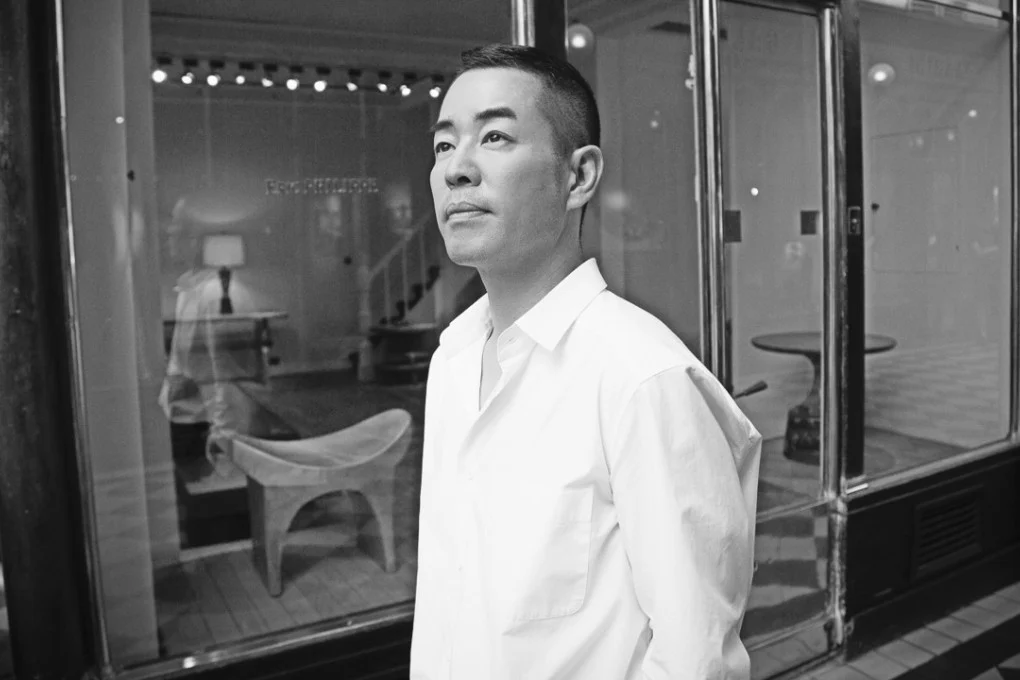
There are designers who create clothes, and then there are designers who quietly rearrange the way we see clothes altogether. Jung Wook-jun , the man behind JUUN.J , quietly rearrange the way we see clothes altogether , he’s never seemed particularly interested in being described that way.
The first encounter with one of his collections tends to produce the same small disorientation. A blazer hangs a fraction lower than instinct says it should. A coat appears almost too generous for the body wearing it. Trousers fall with a different logic. Shoulders read as architecture rather than structure. Nothing is unrecognisable, exactly , it’s tailoring, still, unmistakably , but it feels as though someone has quietly rewritten the sentence while keeping all the same words.
It isn’t fashion trying to provoke you. It’s tailoring, very calmly, asking whether we’ve been wearing the same suit for far too long.
A Suit With Nothing Left to Prove
For most of its modern history, tailoring has functioned as fashion’s safest dialect , the perfect jacket, the correct shoulder, the exact proportion, endlessly refined and polished until elegance itself began to feel almost predictable, a formula more than a language. Entire luxury houses built their identities on preserving that formula intact, season after season, treating deviation as risk rather than possibility.
Jung Wook-jun, trained at ESMOD Seoul and graduating in 1992, never seemed to share that reverence for preservation. He built his first label, Lone Costume, in 1999, developing a following on the Seoul circuit long before Korean fashion had any real claim to global attention. When he relaunched under his own initials in 2007 and stepped onto the Paris Men’s Fashion Week calendar for the first time, he brought with him a term of his own coinage , “street tailoring” , a phrase that, at the time, sounded almost like a contradiction. Two decades on, it reads more like a prophecy.
What he did, in essence, was take tailoring’s oldest rules and begin pulling gently at their seams , stretching proportions, folding silhouettes back onto themselves, discovering along the way that the result could remain elegant, and occasionally become more elegant for the disruption. That instinct, more curiosity than confrontation, eventually hardened into a signature the rest of the industry would spend years catching up to.
The Quiet Radical
Fashion enjoys mythologising the designers who invent something entirely new, though in truth that almost never happens. Most of the industry’s genuinely significant figures simply look at an old idea from an angle nobody else thought to try. That was JUUN.J’s real contribution to menswear , not the rejection of the suit, but the refusal to accept that it had to behave the way it always had.
Jackets lengthened. Trousers widened. Military references sat comfortably beside couture-level construction, an instinct Jung has traced back to his own conflicted relationship with uniform during South Korea’s mandatory service , clothing he says he once found unflattering, until three years in taught him precisely how practical, and how quietly beautiful, that discipline could be. Streetwear, meanwhile, stopped behaving like tailoring’s opposite and became, in his hands, part of the very same sentence.
Looking back now, it’s genuinely difficult to remember how radical any of this once felt. Oversized tailoring has since become a kind of universal language , luxury houses, fast fashion, independent labels, all fluent in the same exaggerated silhouette JUUN.J was exploring while menswear was still deep in its obsession with precision fit and restrained proportion. His early collections belonged, in a real sense, to a future that hadn’t arrived yet, which may be exactly why they’ve aged with such little friction. The best designers rarely predict a trend outright. More often, they simply get there first and wait.
Structure Beneath the Experiment
What distinguishes JUUN.J’s body of work from mere provocation is that nothing about it ever feels improvised. There is always a discipline holding the exaggeration together , every oversized sleeve still understands classical tailoring’s underlying logic, every dramatically scaled coat still respects its own construction, every unusual proportion is supported by a level of technical fluency that keeps the whole thing from tipping into costume. You can only push a boundary that far once you genuinely understand where it came from, and understanding is, unmistakably, where Jung started.
Fashion has always been fond of its binaries , formal against casual, luxury against streetwear, classic against contemporary , and JUUN.J has spent the better part of two decades quietly demonstrating that those oppositions were never as fixed as the industry liked to pretend. A precisely tailored overcoat can share a runway with cargo trousers. A military jacket can feel entirely at home in Paris. An exaggerated silhouette can still, somehow, read as restraint. Somewhere in the space between those ideas, he built a vocabulary that belongs unmistakably to him , recognised, by 2016, with an invitation to Pitti Uomo as its first-ever Korean guest designer, a distinction that placed his name formally beside the industry’s most established voices.
An Influence That Never Announced Itself
It has become genuinely difficult to discuss contemporary menswear without tracing at least a portion of it back to what Jung Wook-jun was doing years before most of the industry caught on , not because every designer working today is imitating him directly, but because so many of them are now asking the same questions he raised quietly, and largely alone, at the start. How much volume can tailoring absorb before it stops being tailoring? Can a suit still register as luxurious once it abandons traditional proportion? Does elegance actually require a perfect fit?
Those questions circulate freely through fashion now. When JUUN.J first raised them, almost nobody was listening.
That, more often than people assume, is precisely how influence tends to move. It rarely announces itself on arrival. It enters quietly, waits patiently for a few seasons, and eventually the industry behaves as though the idea had always existed, without quite remembering who introduced it.
What This Means for Korean Fashion
There’s something worth sitting with when you place JUUN.J’s career alongside Korean fashion’s broader trajectory. Designers like Woo Young-mi spent decades establishing the sheer confidence required for Korean luxury to exist entirely on its own terms, without apology or translation for a Western audience. JUUN.J took the next, harder step. He demonstrated that Korean designers didn’t need to enter the global conversation politely, asking for a seat , they could challenge the conversation’s own assumptions, without theatrics, simply by presenting garments that asked better, sharper questions than the room was used to hearing.
Walk through Paris during Fashion Week today and oversized tailoring no longer raises an eyebrow. Long coats drape over wide-legged trousers. Blazers extend past the fingertips. Structure and softness now coexist comfortably inside the same garment. Menswear moved forward, decisively , and it’s tempting, in hindsight, to imagine that evolution as something inevitable, something that simply happened on its own.
It rarely does. Someone always takes the uncomfortable first step , presents the collection that makes an audience hesitate before it quietly becomes, a few seasons later, the new common sense. For the better part of two decades, that designer has been Jung Wook-jun. Not chasing novelty for its own sake. Not chasing attention. Simply refusing to accept that tailoring had already said everything it had to say.
Trends, inevitably, fade. The better questions tend to stay.