 111
111 2
2 3
3 4
4 5
5 6
6 7
7 8
8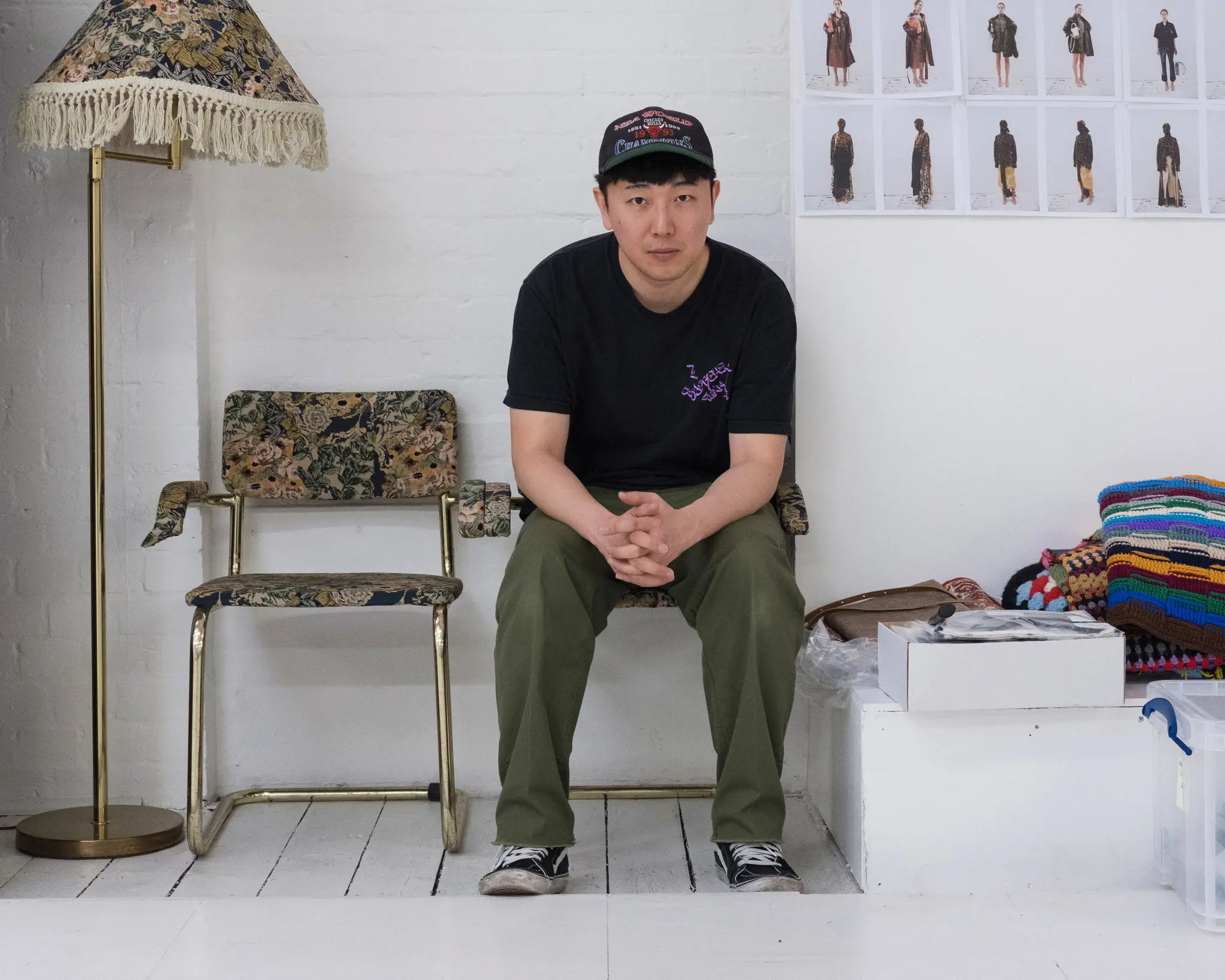
Fashion has always loved sorting designers into neat national boxes. Belgian. Japanese. Italian. British. French. It makes the industry easier to explain at a glance, easier to write a headline about. Except the most interesting designers rarely fit inside a single box, and Rok Hwang has never really tried to.
Ask someone where his fashion actually belongs and you’ll get a different answer depending on who you ask. Some will say London, where he trained and spent his early career. Others will point to Paris, where his collections have shown every season since 2019. Others still will mention Seoul, the city he was born in before his family moved to Austin, Texas, when he was young — a childhood spent, by his own account, surrounded by rich tapestries and Americana-style florals that still surface, quietly, in his colour choices today. Hwang doesn’t seem particularly interested in resolving that question. He built his identity around how he sees clothing, not around where he happens to be from.
FROM A GRADUATE SHOW TO PHOEBE PHILO’S FIRST TEAM
The origin story is, by fashion standards, almost absurdly fast. Hwang moved to London at nineteen and enrolled at Central Saint Martins in 2004, earning a BA in menswear before moving into an MA in womenswear under the legendary, famously demanding tutor Louise Wilson , the same programme, around the same period, that produced Simone Rocha, a classmate Hwang has credited as part of what made the school’s energy so formative. His 2009 graduate collection won first prize in the school’s competition, and the win did something that essentially never happens to a graduating student: it put him directly on Phoebe Philo’s radar, just as she was assembling her first design team for her debut at Céline.
Hwang has called the moment “quite magical,” and it’s easy to see why , going straight from a graduate runway to helping shape one of the most influential design languages in contemporary fashion is about as fast a start as the industry offers anyone. He spent several years at Céline under Philo, then moved into freelance design roles at Chloé and Louis Vuitton, absorbing three genuinely different, distinctly precise ways of thinking about womenswear before he ever put his own name on a label.
A DECONSTRUCTION THAT ASKS DIFFERENT QUESTIONS
He launched Rokh in 2016, and the brand’s identity crystallised quickly around an idea that’s easy to state and remarkably hard to execute well: familiar garments, gently interrogated rather than dismantled. A trench coat that looks as if it was left unbuttoned mid-construction. A blazer that opens in a place tailoring convention says it shouldn’t. A white shirt that refuses to sit exactly where history insists it must. Nothing in a Rokh collection looks broken. It looks like it’s been given permission to move past whatever rule originally built it.
Fashion throws the word “deconstruction” around so often it’s nearly lost its meaning , for a lot of brands, it simply means taking a garment apart. Hwang’s version is more precise than that, and more interesting: it’s less about disassembly and more about asking whether a piece needed to be assembled that particular way to begin with. The trench coat stays a trench coat. The white shirt stays a white shirt. The tailored jacket still respects the fundamentals of tailoring. But each familiar object starts behaving slightly differently under his hand , a conversation rather than a uniform, is how it tends to read on the body.
That restraint is exactly why his runway pieces have a longer life than most experimental design tends to. A lot of avant-garde fashion is built almost exclusively for the runway moment , striking in photographs, unlivable in an actual wardrobe. Rokh’s clothes stay wearable, and not because the ideas get watered down to get there. It’s because the house understands, structurally, what a real wardrobe actually needs, and treats curiosity and elegance as compatible instincts rather than opposing ones.
THE PRIZE THAT CONFIRMED IT
The industry noticed quickly. In 2018, Rokh was nominated for the LVMH Prize and won the runner-up Special Prize , a €150,000 grant paired with a year of mentorship from the LVMH group, which Hwang has said he used specifically to build infrastructure the brand hadn’t had the resources for yet: specialised hires, stronger visual merchandising, a more direct line to the actual customer rather than just the press. The following year, Rokh opened Paris Fashion Week as one of three newcomer houses added to the official calendar — genuine confirmation, from the industry’s most guarded institution, that the label had earned a permanent seat.
PRECISION BUILT FOR SCALE, NOT JUST FOR THE RUNWAY
What’s kept Rokh relevant since isn’t just the runway output , it’s proven surprisingly effective at translating that precision into mass-market collaboration without losing its identity in the process. A 2024 partnership with H&M brought Hwang’s transformable, deconstructed silhouettes to a dramatically larger audience, selling through 95% of stock within three days. A separate collaboration with Uniqlo’s GU line pushed the same instinct even further downmarket, proof that the underlying ideas , buckles and buttons in unexpected places, garments that can be worn more than one way , translate at almost any price point, because the ideas were never really about exclusivity to begin with.
WHY THE KOREAN INFLUENCE ISN’T WHERE PEOPLE LOOK FOR IT
It’s tempting, and fashion journalism does love this framing, to describe Hwang as a bridge between East and West. It’s a tidy narrative. It’s also a little too convenient for what’s actually happening in the clothes. Rokh’s collections don’t read like a negotiation between two cultures stitched together for effect. They read like the natural output of someone who’s lived across more than one world for long enough to stop treating them as separate categories that need reconciling.
If there’s a genuinely Korean sensibility running through the house, it isn’t visible through overt cultural
reference , no hanbok silhouettes, no obvious folklore. It shows up instead as an attitude: restraint, precision, a willingness to let a garment breathe rather than overwhelm the body wearing it. Sometimes identity reveals itself most clearly through what a designer chooses not to do, and Hwang has built an entire visual language on exactly that kind of quiet omission.
LOUDER FASHION MOVED ONE WAY. ROKH MOVED THE OTHER.
Over the past decade, plenty of the industry chased volume , bigger shoulders, bigger logos, bigger campaigns, bigger personalities dominating bigger headlines. Hwang built in the opposite direction and proved, gradually rather than instantly, that intelligence could still hold attention, that subtlety could still be memorable, that a genuinely well-cut coat could generate as much real conversation as the loudest spectacle on a runway that season. Fashion rarely rewards subtlety on the first pass. It tends to catch up a few seasons later, once everyone else has finished shouting.
Look around the industry now and you’ll notice how many designers have started asking Rokh’s kind of questions in their own way , detachable elements, convertible garments, familiar tailoring viewed from unfamiliar angles. Hwang wasn’t the only one exploring that territory. But he’s asked the questions with unusual clarity, without excess noise, without needing to explain the idea before the clothes could speak for it , which is probably why the work still reads as genuinely contemporary rather than trend-adjacent, nearly a decade into the label’s life.
He isn’t chasing the future particularly hard. He’s quietly re-examining the present, one recut shoulder and one reconsidered coat at a time — proof that the biggest shift in a wardrobe doesn’t always require inventing something new. Sometimes it just requires looking, more carefully than anyone bothered to before, at something everyone already assumed they understood.