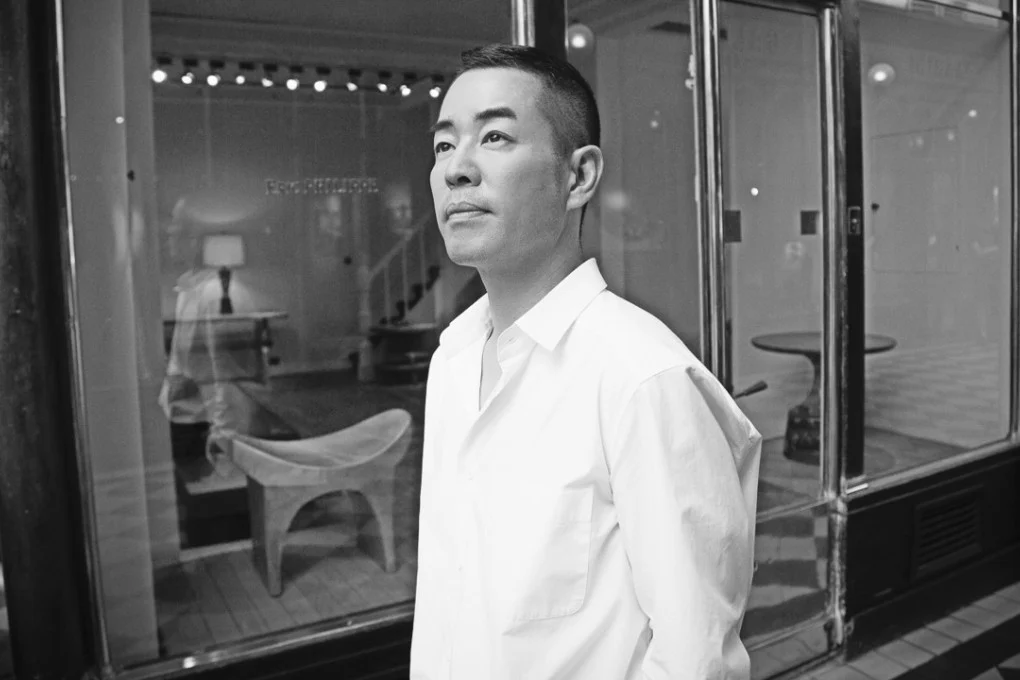
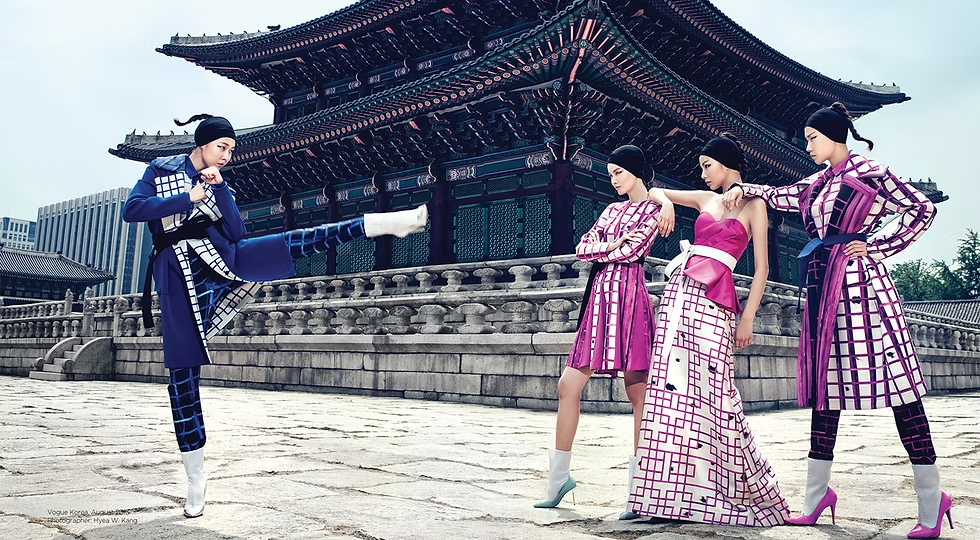
The moment a designer starts looking backward, there’s a temptation to make the past instantly visible , traditional motifs turned into prints, historic symbols flattened into decoration, cultural references enlarged until nobody could possibly miss where they came from. Lie Sang Bong has spent more than forty years refusing that shortcut. For him, Korean heritage was never something to place on top of a garment. It was something to build the garment from.
FROM THE STAGE TO THE ATELIER
Lie’s route into fashion wasn’t a straight line from design school. He trained at the Seoul Institute of the Arts in broadcasting and entertainment, working as an actor before a win at the Central Design Contest in 1983 redirected his entire career. He spent the years that followed making couture privately for individual clients out of his own Seoul atelier, and didn’t present a proper ready-to-wear collection until 1993, when “The Reincarnation” debuted at Seoul Fashion Week and pulled the attention of both celebrities and press almost immediately. By 1999, the mayor of Seoul had named him the city’s Designer of the Year , recognition, at that point, entirely built on a domestic reputation, years before anyone in Paris knew his name.
That changed in 2002, when Lie took the brand to Paris with a collection titled “The Lost Memoir,” becoming one of the earliest Korean designers to establish a genuine, ongoing presence on the European fashion calendar. Twelve years of showing there followed before the label made its New York Fashion Week debut with its Fall/Winter 2014 collection , a slow, deliberate international build rather than a single breakout moment, and one that ran in parallel with an increasingly high-profile client list: Beyoncé, Rihanna, Lady Gaga, Lindsay Lohan, Rosario Dawson, Kelly Rowland, Juliette Binoche, and South Korea’s own First Lady have all worn his work over the years, alongside sustained coverage in Vogue, Vanity Fair, W, The New York Times and Harper’s Bazaar.
HERITAGE AS RAW MATERIAL, NOT DECORATION
None of that international traction, though, is really the interesting part of his story. What sets Lie apart is what he actually does with the cultural material his work keeps returning to. Hangul. Dancheong, the vivid decorative painting found on traditional Korean architecture. Changsal, the latticed wooden window and door patterns common in hanok houses. The mugunghwa, Korea’s national flower. Geometric structures pulled from Korean architectural tradition. All of it shows up across his collections, but almost never as recognisable costume. It arrives broken apart, rearranged, abstracted down to line, colour, proportion and movement. The reference stays legible to anyone who knows what they’re looking at. The context around it changes completely.
His relationship with Hangul specifically goes well past surface decoration. He’s described the Korean alphabet as the thing that first ignited his artistic instincts, and he’s taken that interest into genuinely unexpected territory , in 2007, he designed the Cyon Shine mobile phone for LG Electronics, one of the first limited-edition phones ever designed by a fashion figure, its casing etched with a modernised Hangul pattern. He’s also worked with Haengnam Porcelain Company on a series of pieces built around the same characters, work significant enough to have entered the permanent collection at London’s Victoria and Albert Museum. Letters become line. Line becomes pattern. Pattern becomes structure. It’s a considerably more sophisticated operation than simply printing Korean script across a T-shirt , culture treated as design material, not decoration bolted on afterward.
AN ARCHITECT WHO HAPPENS TO WORK IN FABRIC
That instinct extends into how he treats the body itself. His collections carry a distinctly sculptural quality , fabric that doesn’t just follow the body’s shape but builds architecture around it, sharp lines, dramatic volume, garments that frequently read closer to constructed objects than to conventional clothing. It’s part of why he’s often been compared to Alexander McQueen in the Korean press , not for any shared visual language, but for a similar willingness to treat a runway collection as a genuine artistic proposition rather than a straightforward commercial one. His reference points outside Korea back that up: 1930s film noir heroines, Bauhaus design principles, Cubism, even, in the brand’s 2023 Fall/Winter collection, a formal collaboration with Vienna’s Belvedere Museum that folded Gustav Klimt’s ornamentation and colour directly into his own couture-level technique.
THE QUESTION AT THE CENTRE OF KOREAN FASHION’S GLOBAL RISE
How do you become globally relevant without becoming generic? How do you take something specific and local and make it land for an audience that’s never encountered it before? There’s no single answer, but Lie has spent four decades testing one particular hypothesis: don’t translate Korean culture outward for an international audience. Transform it into something that doesn’t need translating in the first place. Architecture doesn’t require translation. Neither does colour, proportion, or a genuinely well-constructed garment.
That universality is precisely what let him build a real international career while keeping Seoul, rather than Paris or New York, at the actual centre of his creative identity , and it’s a big part of why he became the inaugural president of the Council of Fashion Designers of Korea, and later Chair-Professor at Hongik University’s Graduate School of Fashion, shaping the generation of designers who came up directly behind him.
BEFORE KOREAN FASHION HAD TO EXPLAIN ITSELF
It’s easy now to treat Korean fashion’s global rise as a recent phenomenon , the K-pop generation, the Seoul street-style boom, the wall-to-wall celebrity presence at every major luxury show. None of that appeared out of nowhere. There were designers laying the groundwork long before any of it became a global fixation, and Lie belongs to the generation that had to actively convince the international industry that Korean fashion had a voice worth listening to on its own terms. He made that argument mostly through the clothes themselves, decades before Seoul became one of the cities the fashion industry now watches most closely.
WHAT HE ACTUALLY TAUGHT KOREAN FASHION
Perhaps the most lasting part of his career isn’t any single collection at all. It’s the permission he helped establish for an entire industry to stop treating identity as a binary choice , Korean or international, traditional or contemporary, art or clothing, Seoul or Paris, heritage or innovation. There was never a real reason to pick a side. The actual opportunity, the one Lie spent forty years demonstrating, was to let all of it coexist in the same garment. That idea feels almost self-evident in Korean fashion today. It wasn’t, for a long time , someone had to prove it worked first, in public, season after season, before it could start to look inevitable.
He didn’t dress the present in history. He taught history how to speak in the present tense , and an entire generation of Korean designers who came after him have been building on that translation ever since, whether they realise it or not.
Etiquetas: