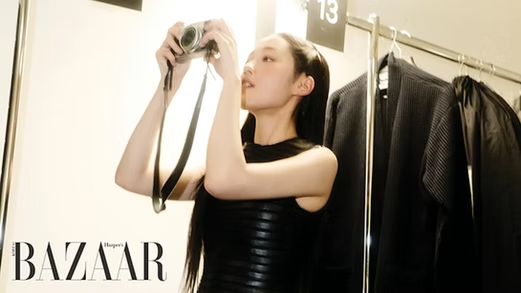
For years, the formula seemed simple. Put a K-pop idol in a major fashion house, place her in the front row, photograph the arrival, and let the internet do the rest. It worked, extraordinarily well. But something more interesting has started happening underneath that formula , and it’s not really about K-pop losing ground. It’s about who else is being let into the room.
THE BALENCIAGA MOMENT
In February 2026, Pierpaolo Piccioli made his first ambassador appointments since taking over as Balenciaga’s creative director, and the roster told its own story. Alongside Winona Ryder and Harris Dickinson stood Roh Yoon-seo , a Korean actress and former model best known for Our Blues, Crash Course in Romance, and 20th Century Girl, with no K-pop career behind her at all. Piccioli was explicit about the logic: “I was not looking for constructed personas, but for real presence,” he told WWD, describing the group as “a new community , different, yet connected by shared values: respect, sensitivity, strength, freedom.” Roh’s own description of the campaign shoot captured exactly what that shift feels like from the inside: “Wearing Balenciaga makes me feel chic, creative, and a little playful. The attitude lives in the dress, and it brings it out of me effortlessly , like I’ve become the protagonist.”
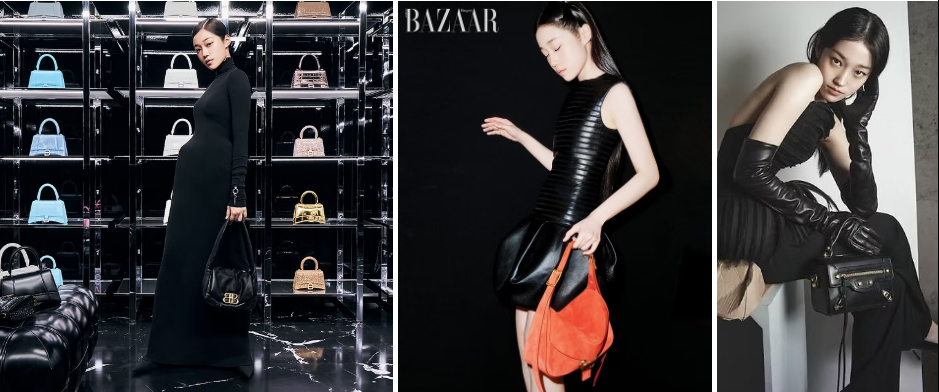
That’s a genuinely different selection logic than the one luxury ran on for most of the past decade, where an idol’s existing fanbase and follower count did most of the explaining. Roh wasn’t chosen because millions of people already stream her comeback single the moment it drops. She was chosen because her image, built through film and television rather than a stage, matched something specific Piccioli was trying to say about the house.
THE ACTORS ARE GETTING THE CALL NOW TOO
Roh isn’t an isolated case. Prada named Byeon Woo-seok, an actor who broke through with 2024’s Lovely Runner, as brand ambassador in November 2024 , and Cartier signed him the same month. Kim Soo-hyun, one of Korea’s most established young actors, joined Prada’s roster the following month. Loewe named actress Lim Ji-yeon its newest ambassador in February 2024, putting her alongside Taylor Russell in the brand’s spring/summer campaign.
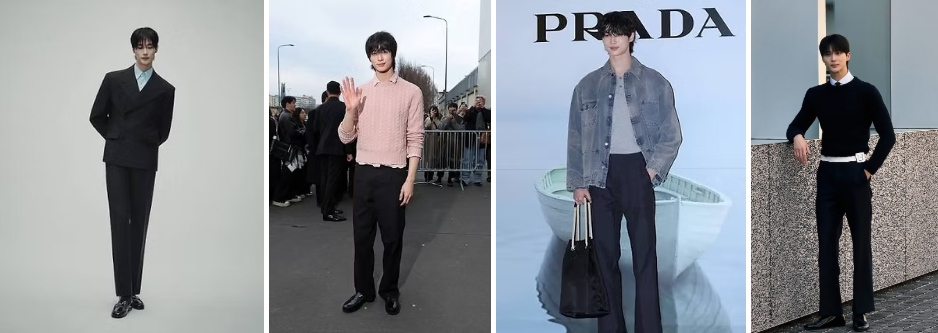
None of these three built their public image primarily through music. All three are now doing exactly the job idols used to do almost exclusively.
THE IDOLS AREN’T DISAPPEARING — THE ROSTER IS JUST WIDER
K-pop’s role in this ecosystem hasn’t shrunk. If anything, the pool of idols luxury is drawing from has widened considerably beyond the handful of most-followed names. Karina of aespa became a Prada ambassador in August 2024; her groupmate Ningning was named Versace’s first female K-pop ambassador that February. Ella, from the newer group MEOVV, was one of the fastest rookie idols ever to land a major ambassadorship, joining Miu Miu in April 2024 alongside more established names like IVE’s Jang Wonyoung and TWICE’s Momo. Gawon followed into Prada’s roster after an AW25 show appearance in Milan. Yeji of ITZY became the face of Roger Vivier in February 2025, described by the house as embodying “a bold and contemporary vision of style.”
It’s worth naming the actual pioneer behind all of this, too: Jang Wonyoung, signed by Miu Miu in 2021 at just seventeen, is generally credited as the idol who proved a K-pop star’s image could anchor a house’s entire aesthetic identity rather than simply borrow it for a season. Everyone named above is, in a real sense, working from the template she set.
WHAT LUXURY IS ACTUALLY BUYING NOW
Put these names side by side and the shift stops looking like a changing of the guard and starts looking like an expanding one. Luxury hasn’t stopped valuing the reach a major K-pop group provides , J-Hope at Louis Vuitton, Jimin at Dior, Jisoo at Cartier and, more recently, Tommy Hilfiger, Jennie’s now-seven-year run with Chanel. What’s changed is that reach is no longer the only currency being evaluated. An actor’s audience, built slowly through a drama’s emotional arc rather than a comeback cycle, offers a brand something a fifteen-second stage clip can’t: a face people already associate with a specific, legible personality rather than a performance.
A HYBRID FIGURE, NOT A REPLACEMENT ONE
The real Korean It-girl right now isn’t exclusively an idol, or exclusively an actress, or exclusively a model. She might be discovered through a Netflix series, followed on Instagram, spotted at Fashion Week, and then re-encountered in a luxury campaign a season later — the platform changes, but the throughline holding audience attention across all of them stays consistent. That fluidity is precisely what Seoul’s entertainment ecosystem has always been unusually good at producing, and it’s why the industry watching it has stopped asking “which idol” and started asking a more interesting question: whose image, across whatever medium built it, actually has something specific enough to say.
All images featured in this article are credited to owners . They are used for editorial and illustrative purposes only, with no commercial intent. All rights remain with their respective owners.