The complete story of Maison Margiela , from a Paris apartment in 1988 to the most subversive couture house in the world
There is a label. It is white. It has four white stitches attaching it to the garment at each corner. It says nothing — no name, no logo, no season, no country of origin. Just four stitches on white cotton and the deliberate, almost aggressive absence of everything that a fashion label is supposed to contain.
That label is the most honest thing any fashion house has ever produced. In an industry built on the premise that the name is the point, here was a designer who said the opposite: the name is nothing. The work is everything. You either see it or you don’t.
The people who saw it built one of the most devoted followings in fashion history. The people who didn’t were confused for years. Both reactions were, in their own way, exactly what Martin Margiela intended.
ANTWERP TO PARIS: HOW IT STARTED
Martin Margiela was born in Leuven, Belgium, in 1957. He studied at the Royal Academy of Fine Arts in Antwerp , the institution that, in 1986, sent a group of its graduates to Paris in a rented truck to show their work without an invitation, producing what became known as the Antwerp Six and effectively announcing a generation of Belgian fashion thinking that the industry hadn’t seen coming.
Margiela graduated in 1980 and spent several years finding his direction before joining Jean Paul Gaultier as an assistant in 1984, where he stayed for three years. Gaultier was already doing something radical with the mechanics of Paris fashion , subverting dress codes, playing with gender, refusing the reverence that the couture system expected of its participants. Margiela observed all of it and took his own conclusions.
In 1988, he partnered with Jenny Meirens and launched his own house from a Paris apartment. The name was Maison Martin Margiela. Everything else was still to be decided. What followed was one of the strangest and most significant careers the fashion world has ever produced.
THE PHILOSOPHY: QUESTIONS INSTEAD OF ANSWERS
The first womenswear show, in 1989, took place in a neglected children’s playground on the outskirts of Paris , a deliberately abandoned, overgrown space that felt nothing like a fashion show was supposed to feel. Models wore masks. Their faces were anonymous. The clothes were the point.
Margiela went on to show in Metro stations, in vacant lots, in empty warehouses. He cast real people from the street rather than professional models. He made clothes from army surplus materials, from old tuxedo jacket linings, from deconstructed Hermès scarves. He turned butcher’s aprons into evening gowns. He photographed Stockman mannequins instead of models for his press materials.
None of this was provocation for its own sake. Margiela was not trying to shock anyone. He was trying to be honest about what fashion was made of and what it was for , and honesty, in the context of 1990s Paris, turned out to be the most radical gesture available to him.
He was fascinated by clothes as objects with histories. A jacket was not a finished thing but a set of decisions that could be unpicked and remade differently. The lining was sometimes more interesting than the exterior. The seam was a design element, not a technical necessity. His work consistently exposed the inner workings of garments , the basting stitches, the padding, the structure under the surface , not as a visual trick but as a genuine argument: that the most interesting thing about a piece of clothing is usually the thing you’re not supposed to see.
He was equally fascinated by time. The beauty of the worn, the faded, the disintegrating. His Replica line , which would eventually become the house’s most commercially powerful product , started as a simple idea: find specific garments in vintage markets and reproduce them exactly as found, with the same proportions, the same details, the same evidence of wear. A specific shirt from a Chicago flea market in 1967. A pair of jeans from a Paris market in 1983. The dates and places printed on the label where a traditional label would have put the brand name.
And then there was the anonymity. Margiela never gave interviews. Never appeared in photographs taken at anyone’s request. Never used the word “I” in studio communications , always “we,” always the collective. This was not modesty. It was a structural decision rooted in a genuine belief: if the designer became famous, the eye would drift toward the designer and away from the clothes. The clothes were more interesting than anything he could say about himself. He was probably right.
THE HERMÈS YEARS: THE RADICAL INSIDE THE INSTITUTION
Between 1997 and 2003, Margiela did something that surprised almost everyone who understood what he was building at his own house: he became the womenswear creative director at Hermès.
From the outside, the appointment made no sense. Hermès was the most heritage-bound, the most materially conservative, the most ceremonially traditional house in Paris. Margiela was the person making evening gowns from butcher’s aprons. The distance between the two seemed, at first glance, almost unbridgeable.
What nobody outside the two houses initially understood was that the distance was mostly superficial. Both Hermès and Maison Margiela were, at their absolute core, obsessed with the same thing: craft. The belief that how something was made mattered infinitely more than what it looked like from a distance. The conviction that real luxury expressed itself through touch and wear and time rather than through visibility and brand recognition.
His Hermès collections were, as a result, some of the most quietly extraordinary work produced at any Paris house in that decade. Technically inventive, exquisitely made, and completely without noise. The clothes did not announce themselves. They revealed themselves, gradually, to the people who wore them. That was very much the Hermès tradition. It was also, in every essential way, very much Margiela.
2009: THE INVISIBLE EXIT
Martin Margiela left his own house in 2009. He did not announce it. He did not give a final interview or a farewell collection or a statement of any kind. He simply stopped , which was, when you thought about it, the most consistent thing he had ever done.
Renzo Rosso had acquired a majority stake in the house in 2002 through his OTB Group, the Italian holding company that also controls Diesel, Marni, Viktor & Rolf and Jil Sander. Margiela had remained creatively involved after the acquisition, but in 2009 that involvement ended quietly and without explanation. The reasons have never been made public.
For the next five years, the house was run by a collective of designers maintaining the codes without a named creative director , exactly the ethos of collective authorship Margiela had always insisted upon. The collections were respected. The house’s loyal following stayed loyal. The fashion world waited.
The 2019 documentary Martin Margiela: In His Own Words was the first and only time the designer spoke publicly about his career. His face never appeared on camera. His voice was heard over archive footage. He gave the world the minimum it needed to understand what he had been doing for thirty years, and no more.
It was, even in retirement, entirely in character.
GALLIANO ARRIVES: THE APPOINTMENT NOBODY SAW COMING
On October 6, 2014, Renzo Rosso announced that John Galliano had been appointed creative director of Maison Margiela.
The fashion world took a moment to process this. Galliano , the former creative director of Givenchy and then Dior, the man who had staged some of the most theatrical and extravagant runway shows in the history of Paris fashion, and who had spent the previous three years in rehabilitation following his abrupt departure from Dior in 2011 , was joining a house built on anonymity, restraint and the radical refusal of spectacle.
On paper it made no sense. In practice it turned out to be one of the most inspired pairings in recent fashion history.
His debut Artisanal collection, presented in London in January 2015, arrived with a kind of emotional weight that the industry had not felt in years. It was simultaneously Galliano and Margiela — the house’s deconstructive intelligence filtered through his baroque sensibility, producing something that had grit and glamour and humour and genuine feeling in roughly equal measure. People in the audience cried. The show was described in the press as a return, a redemption and a revelation, sometimes in the same sentence.
The decade that followed was genuinely extraordinary. Galliano pushed the house into territory it had never occupied , and somehow did it without dismantling what Margiela had built. The Tabi boot became under his direction a global cultural phenomenon, moving from the avant-garde into streetwear and eventually into the kind of mainstream recognition that would have been unthinkable when Margiela first showed it in 1989. The Artisanal shows became a form of serial world-building that felt more cinematic than fashion , each one a continuation of a story only Galliano could have conceived.
He explored technology in shows where iPhones were strapped to models’ ankles. He staged a collection that referenced the two World Wars with nurses’ uniforms and soldier silhouettes, releasing it alongside a press statement that read: “Stories of hope, heroines, and liberation are forgotten as history draws ever closer to repetition.” During the pandemic, when physical shows became impossible, he made fashion films that proved the format could carry as much weight as a runway.
And then, in January 2024, under the Pont Alexandre III on the banks of the Seine at night, surrounded by the sounds of a gospel choir and a live performance by Lucky Love, he staged what became immediately and universally recognised as one of the most significant fashion shows of the decade. Models moved through the setting like characters from a 1930s Paris that existed only in his imagination , teetering, lurching, arms outstretched as if navigating a world just slightly beyond their control. Gwendoline Christie in a tiered latex gown, her face painted into something porcelain and unsettling by Pat McGrath, walked through it all like the most beautiful and most disturbing thing anyone had put in a fashion show in years.
Everyone who saw it sensed it felt like a final act. In December 2024, Galliano confirmed it. After ten years and a body of work that had genuinely expanded what Margiela meant, he stepped down.
GLENN MARTENS: THE THIRD CHAPTER
The announcement of Glenn Martens as the house’s third named creative director came in January 2025. The forty-two-year-old Belgian designer , a graduate of Antwerp’s Royal Academy of Fine Arts, just like Martin Margiela , arrived with credentials that made the appointment feel less like a surprise than a logical inevitability once it was made.
His ten years at Y/Project had established him as one of the most technically inventive designers working in Paris. His five years at Diesel had produced one of the most celebrated brand resurrections in recent fashion history , viral runway shows, collections that spoke to a generation that had written the brand off entirely, a creative energy that made a legacy denim label genuinely exciting again. His 2022 guest collection for Jean Paul Gaultier couture had been one of the most discussed pieces of fashion that year.
Rosso’s statement at the announcement captured the appointment’s logic precisely: two Belgian designers from the same school, both technically obsessed, both rooted in a tradition of creative thinking that finds its most natural expression in the deconstruction and reconstruction of the familiar.
Martens debuted at Maison Margiela on July 9, 2025, at Le Centquatre , the same cultural space in Paris’s 19th arrondissement where Martin Margiela had staged his final collection in March 2009. The choice of venue was not accidental. It was the first sentence of a declaration about where he intended to begin.
The walls of the basement space were covered with torn, crumpled, peeling wallpaper , referencing Margiela’s lifelong fascination with trompe l’oeil while also conjuring something closer to faded grandeur, to the beauty of things that have been marked by time. The invitation to the show was an engraved silver spoon. Before a single look appeared, the show had already said something specific about its intentions.
What followed was a collection rooted in the visual tradition of Flemish art , the draped metallic velvet recalling the golden luminosity of Jan van Eyck’s canvases, the sculptural silhouettes echoing the statuary of Gothic cathedrals, the patterns lifting motifs from the wallpapered interiors of sixteenth-century Flemish domestic spaces. Transparent plastic sculptures worn over clear plastic dresses. Enormous undulating gowns in rippling metallic organza. Jersey garments that appeared to have been pressed against the body as if by an invisible force. The Tabi boot reimagined as a Tabi Claw, the house’s most recognisable shoe pushed further than it had ever previously been taken.
Prior to the show, Martens had told Vogue Business that he felt the founding DNA of the house had been “referenced ad infinitum” , that what he wanted to do was not reference those references but go back to the source material itself and reclaim it directly. The collection was received as a largely successful execution of that intention: genuinely rooted in Margiela’s founding codes without feeling nostalgic, genuinely Martens’ own without feeling imposed on a house he had just arrived at.
His first ready-to-wear collection, presented in October 2025 for Spring/Summer 2026, opened with a live orchestra of children playing their own interpretations of classical composers , a somewhat on-the-nose but effectively moving image for a young designer finding his own voice within a layered tradition. The collection moved through the founding codes of the Margiela era , the lapel-less coats, the apron structures, the reconstructed denim, the translucent layering, the deliberately taped and crinkled surfaces , and remixed them into something that felt alive rather than archival. The press received it warmly. The house moved forward.
THE CODES: WHAT MAKES A MARGIELA PIECE MARGIELA
Across thirty-eight years and three creative directors, a set of visual and philosophical codes has persisted at the house with a consistency that is, in itself, one of the more remarkable achievements in contemporary fashion.
The blank white label with four stitches is the most iconic. It functions as a signature for people who know exactly what they are looking at and as nothing at all for those who don’t , which is, in practice, the perfect realisation of Margiela’s original intention.
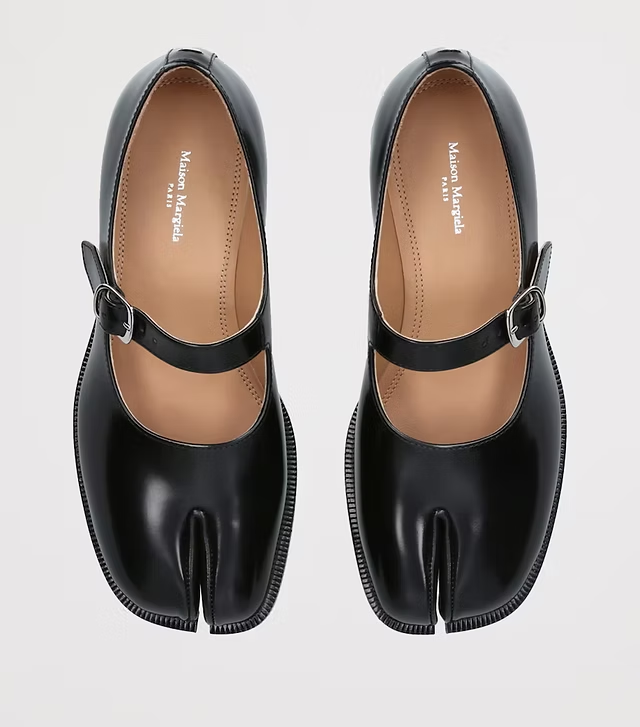
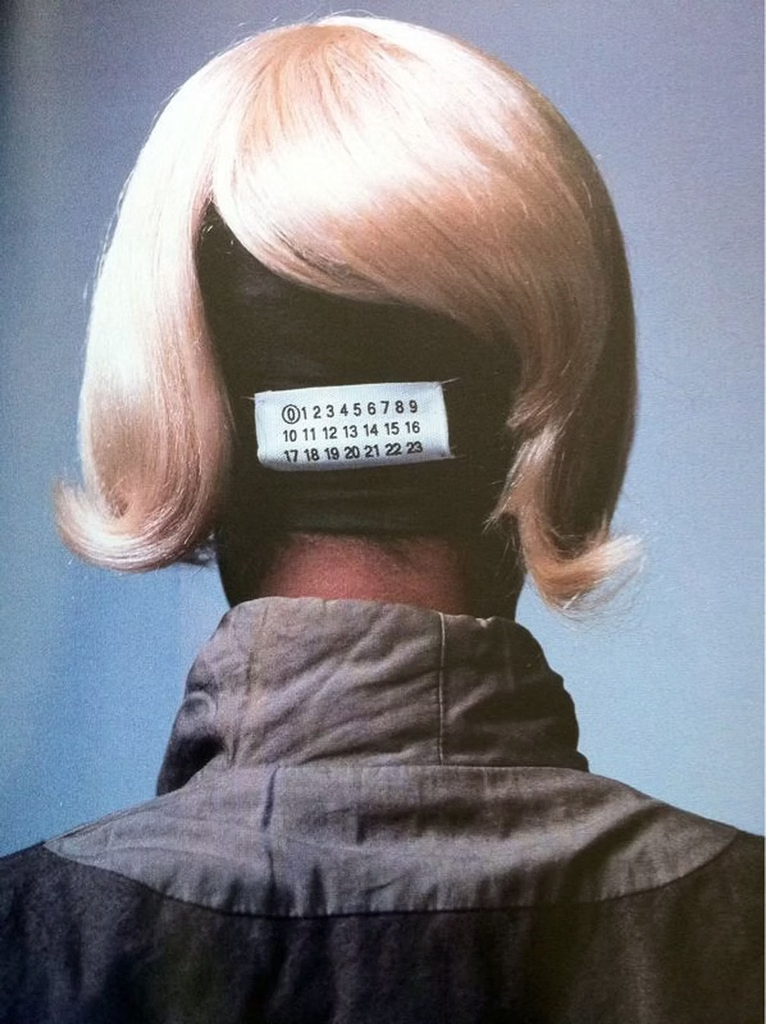
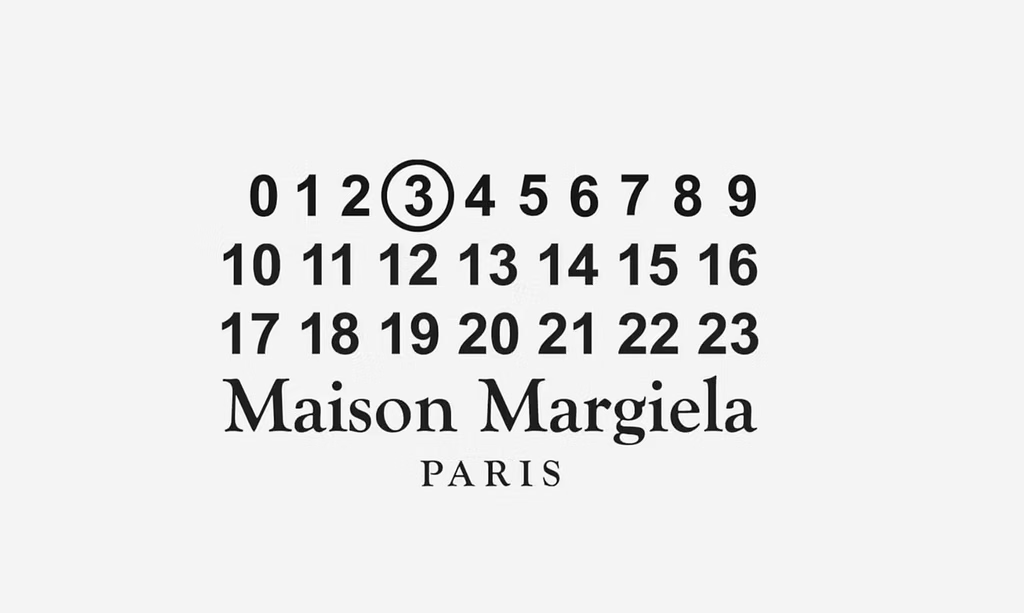
The Tabi shoe , inspired by a traditional Japanese sock split between the big toe and the rest of the foot , has appeared in every era and in every possible material, and divides opinion as reliably in 2026 as it did in 1989, which suggests it is doing exactly what a good design element should do. The oversized silhouettes, deliberately scaled up so that garments fall off the body in specific rather than accidental ways, have reappeared across every collection under every creative director. The exposed lining, the visible seam, the unfinished hem.
And the colour white. The studio has always been white. The staff have always worn white lab coats. White as the absence of distraction , as a philosophical choice about what you want the eye to focus on when it enters a room.
These are not styling decisions. They are arguments. The genius of Galliano’s decade was to make those arguments at a completely different volume without surrendering them. The early evidence of Martens’ tenure is that he intends to make them in a third register , darker, more Gothic, more explicitly rooted in the Flemish visual tradition he shares with the founder. A different argument. The same language.
REPLICA: WHEN THE PHILOSOPHY BECAME A PHENOMENON
No account of Maison Margiela in 2025 and 2026 is complete without addressing what has happened to the Replica fragrance line , the most commercially successful expression of the Margiela philosophy, and the one that has introduced the house to the largest number of people who have never thought about the blank white label.
The Replica line launched in 2012, applying to scent the same principle Margiela had always applied to clothing: take something real and specific , a particular moment, a particular place, a particular sensory experience , and reproduce it with precision. Each fragrance is named for a time and a location. Jazz Club. Flower Market. By the Fireplace. Beach Walk. Not fantasies of luxury but reproductions of experiences. Not aspiration but memory.
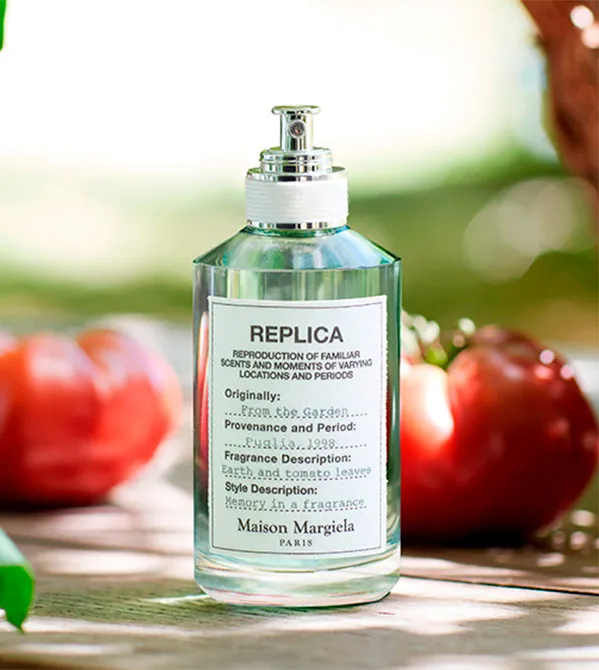
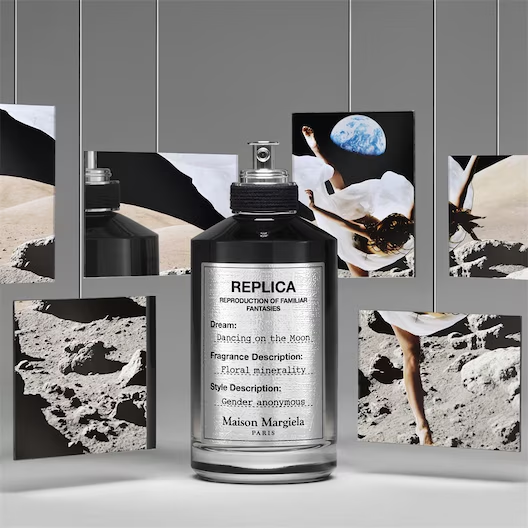
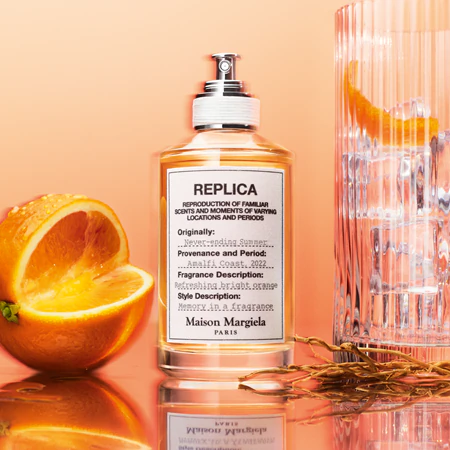
By the Fireplace became something close to a cultural phenomenon, particularly when it found its audience on TikTok , a platform that did not exist when the house was founded and that Margiela himself would almost certainly regard with deep suspicion. The irony of a brand built on anti-marketing becoming viral through the internet’s most algorithmic platform is not lost on the fashion world. The brand’s response, characteristically, has been to say very little about it and let the fragrance speak for itself.
The Replica line is now part of a licensed products portfolio , fragrance, eyewear and accessories , that generates more than $200 million in annual revenue. Total brand revenues are approaching $500 million. The house that was founded on a radical rejection of commercial logic is now a commercially significant institution by almost any measure. The radical rejection of commercial logic, it turns out, was the most commercially interesting thing anyone in fashion had done in years.
CONCLUSION: WHAT MARGIELA MEANS NOW
In the documentary released in 2019, Martin Margiela spoke about his work for the first time. His face remained invisible throughout. His voice was heard over images of the things he had made , garments, shows, studio photographs. He offered the minimum the world needed to understand what he had been doing and nothing beyond that minimum.
It was, even from retirement, entirely in character.
Margiela the man remains as invisible as he has always chosen to be. Margiela the house is now in its third creative chapter, led by a designer who studied at the same Antwerp school, shares the same Belgian instinct for darkness and deconstruction, and chose to make his debut in the exact room where the founder made his final exit. Glenn Martens did not choose Le Centquatre by accident. He chose it as his first sentence , a statement about origins, about continuity, about the specific and demanding responsibility of carrying something forward that was built to last.
The blank white label with four stitches is still attached to every mainline piece. The Tabi boot still divides opinion at thirty-eight years old, which means it is still doing its job. The Replica fragrances are still being discovered by people who may never know that the brand they love once staged its shows in abandoned playgrounds and photographed mannequins instead of models.
Maison Margiela built a world that was unlike every other world fashion had ever made , more honest, more questioning, more interested in the person underneath the clothes than in the image the clothes were meant to project. Thirty-eight years later, with revenues approaching half a billion and a third creative director who may be the most naturally suited appointment the house has ever made, that world is still the most interesting one on the calendar.
It always was. You just had to know where to look.
All images featured in this article are credited to owners . They are used for editorial and illustrative purposes only, with no commercial intent. All rights remain with their respective owners.