 111
111 2
2 3
3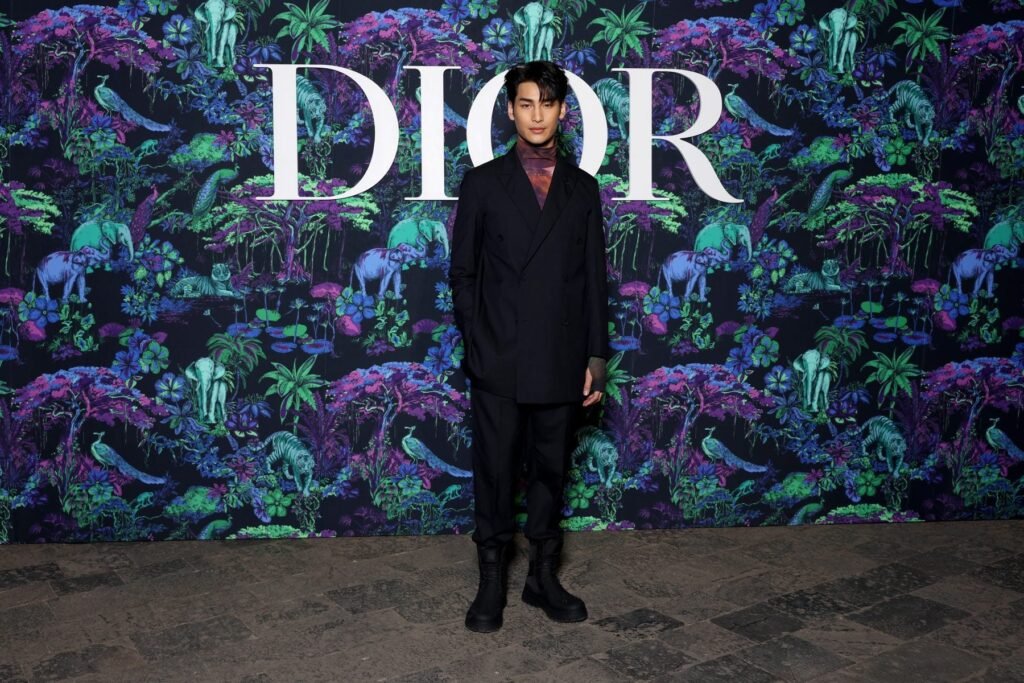 4
4 5
5 6
6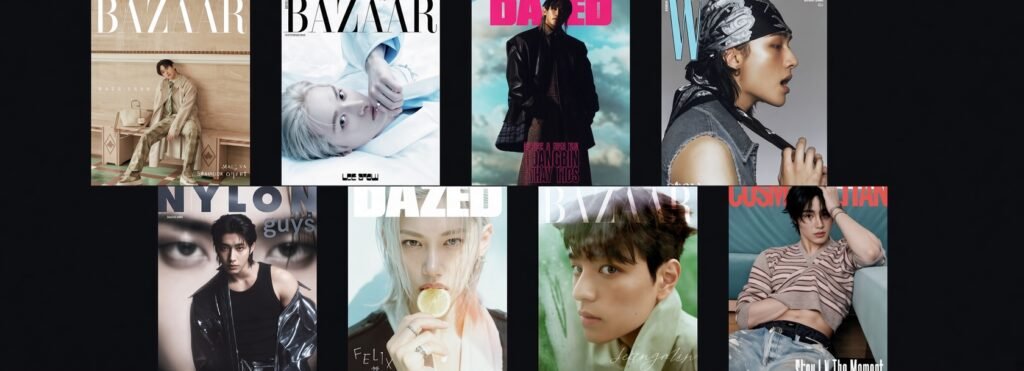 7
7 8
8
Nobody in the room has said a word yet, and somehow everyone already knows exactly where they stand.
That’s the trick fashion has been pulling for centuries, and most of us never catch it happening. A man walks into a boardroom in the same grey T-shirt he wore last Tuesday, and last Wednesday, and everyone reads him instantly , not as someone who ran out of laundry, but as someone who’s decided he has better things to think about than what he’s wearing. A designer slips out the side door after her own show, in something so plain it’s practically camouflage, and that plainness is somehow the loudest thing in the building. A woman crosses the street in a coat that doesn’t match anything you can name, and the three people on the block who know what they’re looking at suddenly stand up a little straighter.
Nothing was said out loud. The message still landed, dead on target, before anyone opened their mouth.
We like to pretend this is instinct. It isn’t , it’s fluency. We’ve been reading clothes as a language longer than we’ve been reading actual language, and the grammar never really goes away, it just gets quieter. Which is, funnily enough, exactly the point. The people who speak this language best are almost never the ones shouting in it.
THE MOST POWERFUL MAN IN THE ROOM IS WEARING THE SAME THING HE WORE YESTERDAY
We’ve all heard the Steve Jobs story so many times it’s practically wallpaper by now, but stay with it for one more second, because it’s still the cleanest example fashion has ever produced. Black Issey Miyake turtleneck. Same Levi’s. Same New Balance sneakers. Every product launch, every keynote, every single day for years , right up there in front of thousands of people who’d watch his every move for a hint of what Apple was about to do next. He wasn’t being lazy. He told Walter Isaacson, flat out, for the biography: he didn’t want to spend a single decision on what he was wearing. So he simply removed the decision. Bought the turtleneck in bulk and never thought about it again.
Zuckerberg runs the same play in a completely different key. Dozens of identical grey tees, folded and ready to go, because , again, in his own words , every choice he doesn’t have to make in the morning is energy he gets to spend on something that actually matters by the afternoon. Where Jobs’ uniform reads almost monastic, like a man who’d taken a vow, Zuckerberg‘s reads generational: a founder who answers to code, not to a dress code, and wants you to clock that the second he walks in.
And it’s not just the tech guys. Jony Ive spent nearly thirty years running Apple’s design studio dressed with the exact same restraint as the products he was making , nothing on him competing for attention with the work. Tom Ford went the completely opposite direction and somehow landed in the same place: black suit, white shirt, unbuttoned to a very precise, very deliberate degree, repeated so consistently over twenty-odd years that at this point it functions less like an outfit and more like a signature. You clock it before you clock the face.
Here’s the thing nobody quite says out loud about all four of them: the uniform was never really about saving time. That’s just the cover story. What it actually does , and this is the part worth sitting with , is announce, without a single word, that this person has stopped needing to prove anything through what they’re wearing. All that leftover energy has gone somewhere else, somewhere the room is meant to assume is more important. And the less effort someone visibly puts into being noticed, the more the room tends to notice.
Power, once you have enough of it, stops needing volume.
WHY THE PEOPLE WHO ACTUALLY RUN FASHION LOOK LIKE THEY COULDN’T CARE LESS ABOUT IT
Here’s the bit that never stops being a little bit funny, once you notice it: the people with the most influence over how the rest of us get dressed are, personally, some of the least “dressed” people in the entire industry.
Nobody committed to this harder than Martin Margiela. Two full decades running his own house, and he never once gave a face-to-face interview, never let himself be photographed, never so much as walked out for a bow at the end of his own shows. Everything the studio put out went under “we,” never “I” , for years, literally faxed. Not shyness. Not a marketing bit, either, whatever the skeptics said at the time. It was a genuine, deeply held conviction: the second the designer becomes the story, the audience’s eyes drift off the clothes and onto him, and Margiela had decided, correctly as it turned out, that the clothes deserved every ounce of that attention more than he did.
Phoebe Philo ran a quieter version of the same experiment across her decade at Céline , barely photographed, almost never interviewed, letting a decade of extraordinary, extremely influential design speak entirely for itself, to the point where most of the public still couldn’t pick her out of a lineup. Yohji Yamamoto has spent close to fifty years working almost exclusively in black , not, as he’s explained more than once, because he dislikes colour, but because colour pulls the eye toward the surface of a garment, and he’d much rather your eye go toward the structure underneath it: how the fabric moves, how it falls, how it shields the body inside it rather than putting that body on display. “My clothing protects you from unwelcome eyes,” he’s said , which might be one of the most quietly radical sentences fashion has ever produced, because it argues that being seen and being present were never actually the same thing.
Different decades, wildly different aesthetics, and yet somehow it’s always the same move. None of them dress to be noticed. All of them get noticed constantly, by an industry that’s spent years trying to work out how. Turns out the answer’s almost embarrassingly simple: the spotlight was never supposed to land on them in the first place. It belongs to the idea. Every bit of personal restraint is just there to make sure it stays there.
PRADA ISN’T PICKING COLOURS. SHE’S STARTING FIGHTS.
This is the part that would make a brand consultant break out in hives, and it’s honestly the most fun part of the whole story.
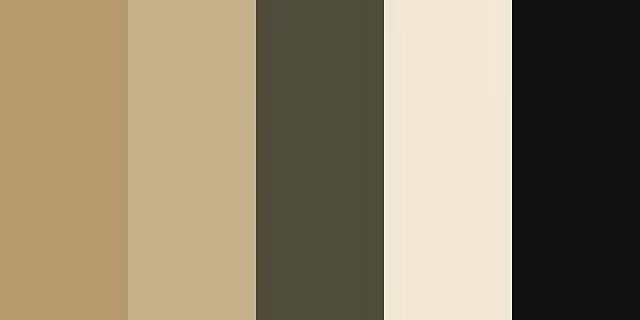
Miuccia Prada uses colours that shouldn’t, by any conventional logic, work. Muddy browns. Greens that sit just slightly off. Mustard. A blue that lands somewhere the eye wasn’t expecting it to land. She studied political science, spent five years training in mime at Milan’s Piccolo Teatro, came up through 1970s Italian feminism , and when she took over her grandfather’s leather house in 1978, she ran it less like a fashion brand and more like an ongoing argument she intended to keep having for the next five decades. Britannica sums up her signature about as well as anyone: clean lines, muted colour, deployed on purpose against an era that assumed luxury meant gloss, gold, and as much skin as you could show. Her whole “ugly chic” era in the ’90s pushed the same instinct even further , awkward proportions, colours nobody asked for , specifically so nobody could consume the image too easily.
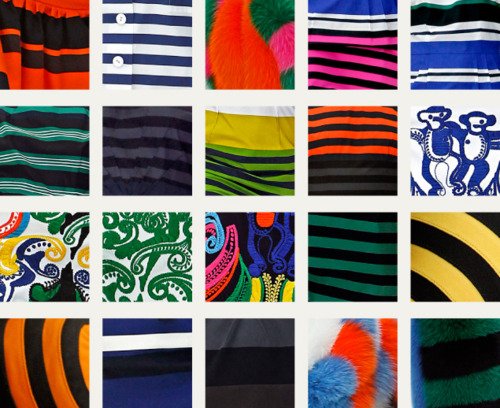
Because that’s actually the mechanism. A palette that resolves too easily gets looked at once and filed away forever. A palette that’s slightly wrong forces a second look, and a third , and by the third look you’ve stopped thinking about the colour altogether and started wondering why on earth she chose it. That’s a completely different, much stickier kind of attention. Prada was never trying to be liked on sight. She was trying to make you come back and look again , and a second look, held a beat longer than it needed to be, is worth infinitely more than an easy first impression that’s forgotten by next season.
THE ROW DOESN’T ADVERTISE. THAT SILENCE IS THE WHOLE STRATEGY.
Mary-Kate and Ashley Olsen founded The Row in 2006 and, near as anyone can tell, have never once run a traditional ad campaign for it. No personal social media from either of them. Guests at the Paris shows have reportedly been asked to leave their phones alone for the duration. A Kellogg School of Management case study built specifically around the brand notes that none of this restraint has slowed anything down , the house is valued anywhere from several hundred million to over a billion dollars, built almost entirely on visibility the founders refused to chase.
When demand for the Margaux bag exploded, The Row didn’t rush to restock or throw up a waitlist to manage the chaos. They just let the wait exist. The scarcity became part of what the bag was worth , which is, incidentally, exactly the logic Hermès has run for decades with the Birkin, where the unpredictability of the waitlist was never a bug to fix. It’s the whole feature, left in on purpose, forever.
There’s a reason this quietly flips almost a hundred years of luxury logic on its head. Thorstein Veblen built his entire theory of conspicuous consumption on the idea that status has to be seen to count. The Row’s success suggests the opposite is now true, at least for the audience that actually matters to them: once logos can be faked over a weekend and anyone with a credit card can buy their way into “luxury,” the real flex quietly becomes withholding. Knowing what The Row is, without a logo ever confirming it for you, has become the status symbol the logo used to be. Don’t chase. Be chased. Simple to say. Brutally hard to actually pull off.
THE PART THAT ISN’T THERE IS DOING MOST OF THE TALKING
Once you start noticing this, you can’t stop, and it’s almost never about the logo. It’s the silence. The amount of empty space around a single product in a shop window. The weight of the box it comes in. The lighting that makes you drop your voice without anyone telling you to. Margiela ran on this exact logic in physical form , white lab coats, shows staged in abandoned lots and disused Métro stations, a blank white label with four stitches doing the job a name was supposed to do. The absence of information was the loudest thing the house ever put out.
Everything communicates. Usually, the thing a house chooses not to show you is communicating the most.
AND ONCE YOU CAN READ THE LANGUAGE, YOU CAN’T UNREAD IT
Here’s where it stops being fashion history and starts being right now.
Fendi named Chris (Bang Chan, of Stray Kids) as its global brand ambassador in its centenary year , and it wasn’t because he’s famous. Plenty of famous people never get that call, and plenty of people who do get it aren’t household names outside their own fandom. It’s because everything about how he moves through the world already said, without a single press release, exactly what Fendi wanted said that year: meticulous, internationally fluent, confident enough that it never has to raise its voice.
The same logic is playing out across the entire industry right now, practically in real time. Felix, from the same group, fronts Louis Vuitton. Jimin represents Dior and Tiffany & Co. Cha Eun-woo is one of Dior’s faces. Sana is a global ambassador for Prada and for YSL Beauty in Japan. Momo represents Miu Miu. Rosé has been Saint Laurent’s global ambassador since 2020, and Anthony Vaccarello, the house’s creative director, has said plainly that it was never about reach , it was that, as he put it, she is Saint Laurent, in how she carries herself, not just in how she wears the clothes.
None of that is advertising, not really , not in the old sense. It’s the exact same language as a turtleneck, a muddy green, an empty waitlist. A house doesn’t hand someone its name because they’re popular. It hands them the name because, without saying a word, they’re already saying the right thing , and in an industry built entirely on signs read before anyone speaks, that’s the only currency that’s ever actually mattered.
Fashion’s spent a century convinced the loudest gesture wins , the biggest logo, the splashiest campaign, the most dramatic entrance. But the examples that last are almost never the loud ones. A turtleneck doesn’t go out of style, because it was never really about style to begin with. It was about everything its wearer chose not to say out loud , and how clearly the room heard it anyway.