A reading list for anyone who has ever wanted to understand not just what fashion is, but why it matters
At some point, most people who care seriously about fashion arrive at the same realisation: the more you know, the more interesting everything gets. The dress on the runway is not just a dress. It is a response to something that happened twenty years ago, or two hundred, or in a different country, or in a political climate that the designer lived through and the audience did not. The more context you carry, the more you see.
These ten books are the ones that give you that context. Some are histories. Some are investigations. Some are biographies that read like novels and reveal, by the back door, things about the industry that no formal history would say directly. None of them are boring. All of them will change something about how you look at a runway, a brand, a trend or a wardrobe.
Start anywhere. But start.
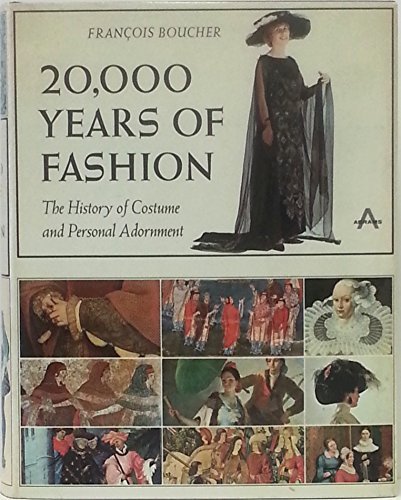
20,000 Years of Fashion: The History of Costume and Personal Adornment — François Boucher (1965)
If you have ever wanted a single book that gives you the full sweep , from the earliest evidence of human clothing through the ancient civilisations of Egypt, Greece and Rome and into the Western fashion tradition as we know it , this is the one. Originally published in French as Histoire du Costume en Occident, Boucher’s monumental work is the book that fashion historians and design schools have been reaching for since 1965. It contains 1,150 illustrations, mostly paintings, etchings and engravings from major museum collections, and it covers not just what people wore but why , how politics, climate, religion and social structure shaped the clothes of every era it examines.
It is a large book in every sense, and not designed to be read cover to cover in an afternoon. Think of it as a reference you return to , something that sits on the shelf and opens differently every time, depending on what you are currently thinking about. Fashion professors have been assigning it for sixty years. There is a reason it never goes out of print.
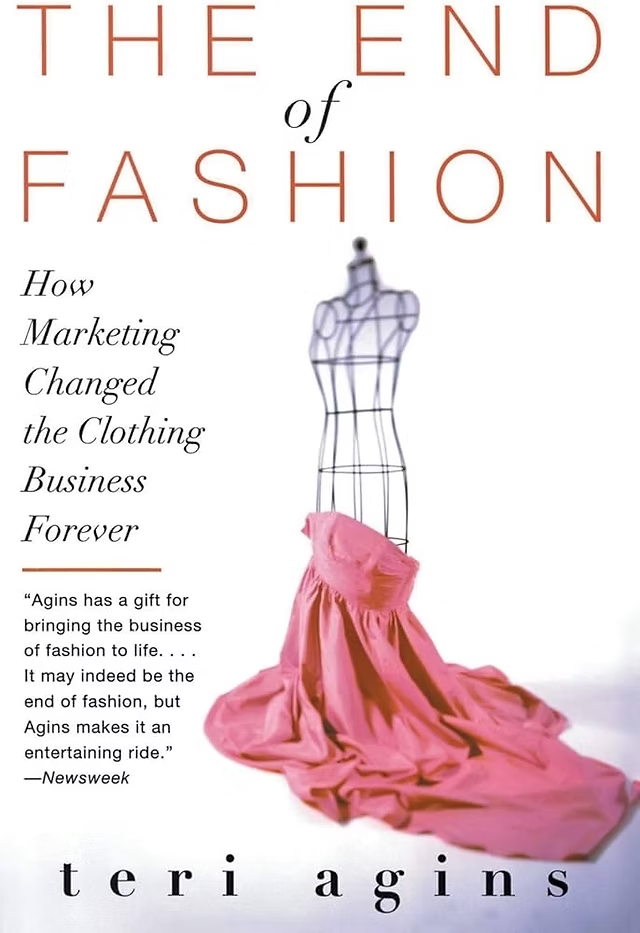
The End of Fashion: How Marketing Changed the Clothing Business Forever — Teri Agins (1999)
Here is the argument this book makes, and it is one that lands harder the more closely you look at the fashion industry today: at some point in the late twentieth century, fashion stopped being about clothes and started being about lifestyle. The shift was not accidental. It was a deliberate strategic pivot made by the biggest names in the business ( Calvin Klein, Tommy Hilfiger, Ralph Lauren ) who realised that selling an image was more scalable, more profitable and more durable than selling a garment.
Agins , who spent decades as a fashion journalist for the Wall Street Journal , documents this shift with the precision of someone who was in the room when it was happening. She traces exactly when and how the designer label stopped meaning “made with unusual skill” and started meaning “priced at a certain point.” If you have ever wondered why the fashion industry works the way it does now, this is where the answer begins. Fashionista described it as the book you should read if you only read one on any essential fashion list. That is not an exaggeration.
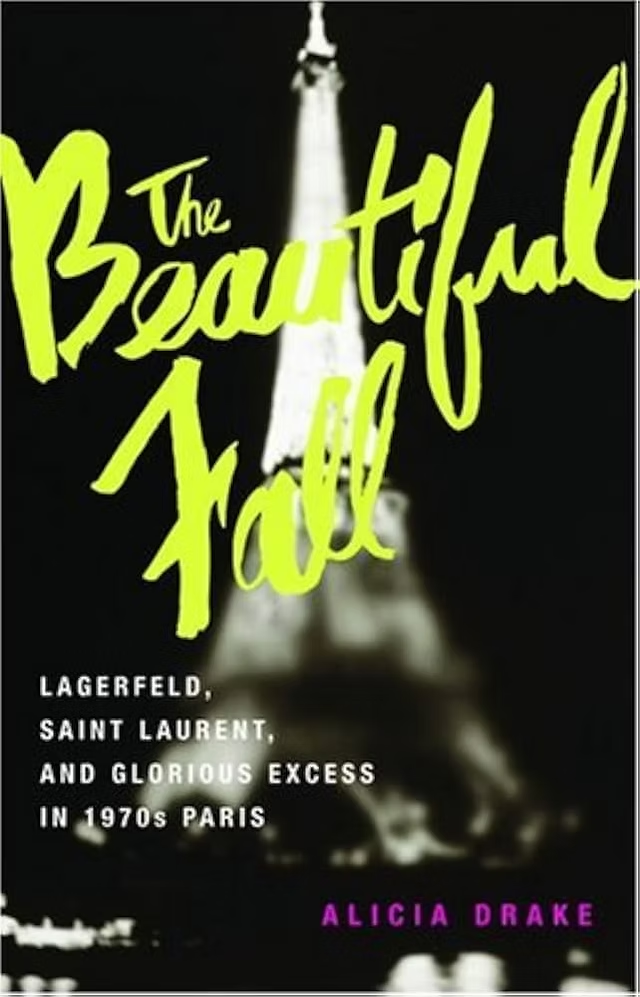
The Beautiful Fall: Lagerfeld, Saint Laurent and Glorious Excess in 1970s Paris — Alicia Drake (2006)
Two men. One city. One decade. And a rivalry so total, so intertwined with ego and desire and drugs and creative genius, that it produced some of the most extraordinary fashion of the twentieth century and eventually destroyed one of them.
Alicia Drake spent years researching this portrait of Karl Lagerfeld and Yves Saint Laurent in 1970s Paris, and the result is one of the most compulsively readable fashion books ever written. The parties, the collections, the cruelty, the beauty , all of it is here, documented with biographical detail so intimate that Lagerfeld actually sued Drake after publication for revealing too much of his personal life. The suit tells you more about the book’s accuracy than any review could. Drake’s 1970s Paris is not nostalgia. It is a fully realised world, with specific smells and textures and catastrophes, inhabited by people who were both giants and deeply human.
It will make you understand Lagerfeld and Saint Laurent , and by extension the houses they shaped , in a way that no amount of press releases or retrospectives can.
Deluxe: How Luxury Lost Its Luster — Dana Thomas (2007)
There is a line that runs from Teri Agins’ End of Fashion directly to this book: the story of what happens when the marketing logic of lifestyle branding is applied to the one segment of the market that was supposed to be immune to it. Dana Thomas , a Paris-based American journalist who spent fifteen years covering fashion and culture for Newsweek , spent years investigating the global luxury industry and what she found was, depending on your relationship with the subject, either a cautionary tale or a revelation.
The short version: the luxury brands you think you know are, in many cases, no longer making what you think they are making, or where you think they are making it. The factories in Italy or France that the marketing implies exist are frequently supplemented , or replaced , by factories elsewhere. The “craftsmanship” is often the craftsmanship of marketing rather than manufacture. Thomas is meticulous and fair, and she names names, which is why Deluxe remains genuinely controversial within the industry more than fifteen years after publication. Her book Deluxe was later adapted into the docuseries Kingdom of Dreams.
Gods and Kings: The Rise and Fall of Alexander McQueen and John Galliano — Dana Thomas (2015)
The same author, a different kind of book , and possibly her best. Gods and Kings is a double biography of the two most significant fashion designers of the 1990s: Alexander McQueen and John Galliano. Both were from working-class British backgrounds. Both studied at Central Saint Martins. Both rose to head the most important fashion houses in Paris : McQueen at Givenchy, Galliano at Dior. And both encountered catastrophe in 2010 and 2011, in different forms, that ended or permanently altered their careers.
Thomas traces both stories simultaneously, weaving them together in a way that makes the parallels and divergences land with the force of genuine tragedy. The fashion is all here , the shows, the collections, the extraordinary creative outbursts of the 1990s , but the book is really about what the industry does to the people who give it their everything, and about the specific intersection of talent, ambition, corporate pressure and personal fragility that defines life at the very top of the fashion calendar. It reads, as one reviewer put it, like an academic version of a tabloid news story. That is meant as a compliment, and it is accurate.
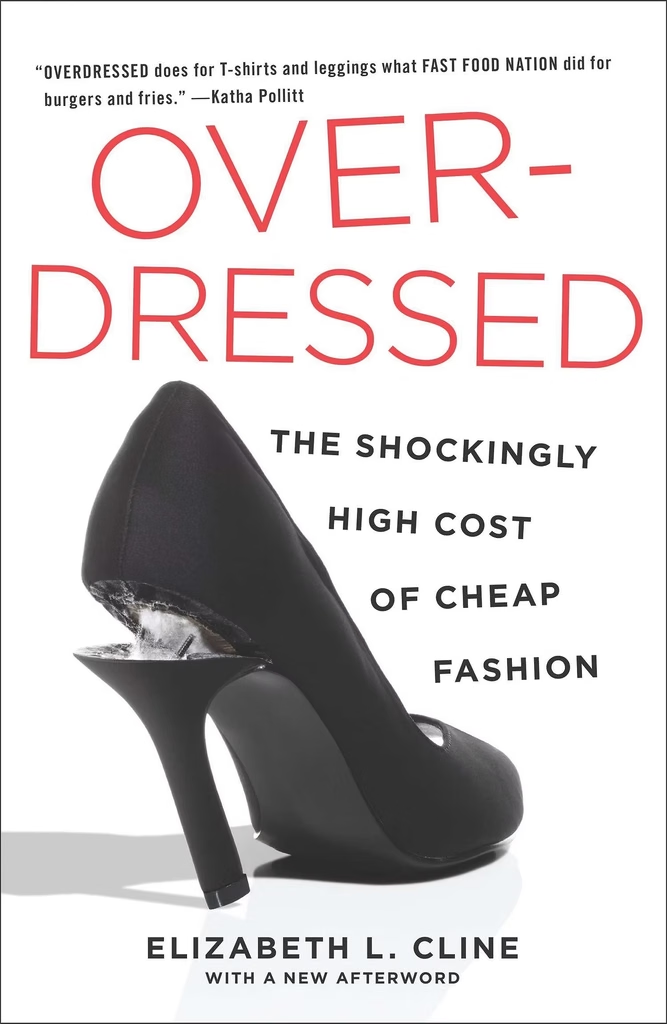
Overdressed: The Shockingly High Cost of Cheap Fashion — Elizabeth L. Cline (2012)
Here is a statistic that this book opens with and that has not lost any of its power in the decade since publication: in 1965, 95 percent of the clothes bought in America were made in America. Today, that figure is below 3 percent. Elizabeth L. Cline spent years investigating how that happened , the economic, political and cultural forces that moved garment production offshore, created the fast fashion model as we know it, and produced a situation in which the average American now buys roughly 68 garments per year and thinks nothing of discarding them within months.
Overdressed is not a polemic. It is a reported investigation, and it is fair to the complexity of what it is documenting , the consumer demand that drives fast fashion as much as the corporate decisions that supply it. It is also, importantly, a book about what happens to all those clothes once we are done with them, which turns out to be one of the least examined and most significant environmental stories of the past fifty years. If you want to understand the full ecosystem of how fashion works , not just the high end, but the whole machine , this is essential.
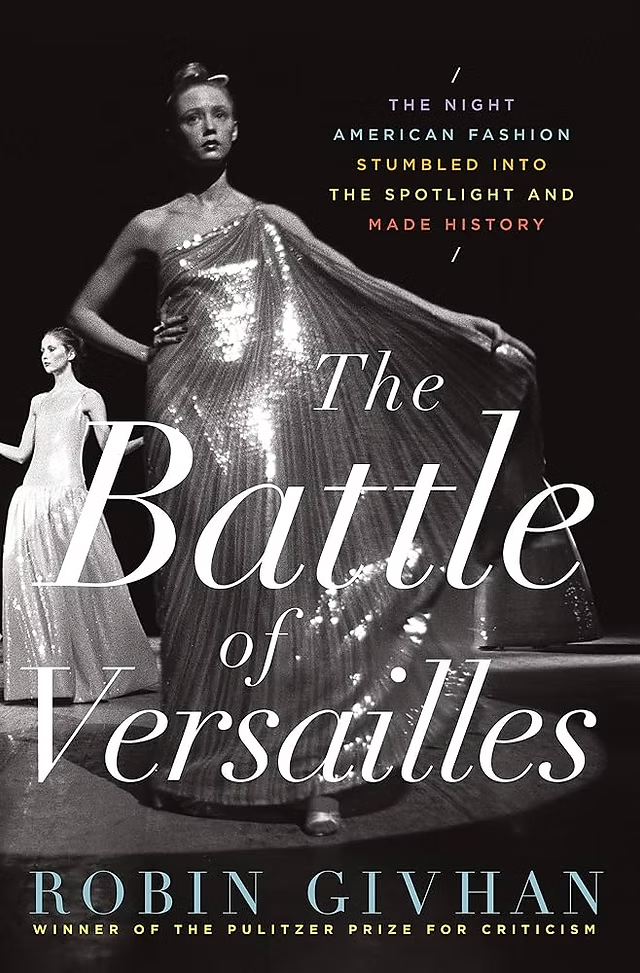
The Battle of Versailles: The Night American Fashion Stumbled into the Spotlight and Made History — Robin Givhan (2015)
On November 28, 1973, five French designers ( Yves Saint Laurent, Pierre Cardin, Hubert de Givenchy, Emanuel Ungaro and Marc Bohan for Dior ) faced five American designers , Bill Blass, Anne Klein, Halston, Oscar de la Renta and Stephen Burrows — in a charity fashion show at the Palace of Versailles. The French arrived with elaborate sets, theatrical productions and the full weight of Parisian haute couture’s institutional authority. The Americans arrived with simpler presentations, better choreography and models who actually moved.
The Americans won. And fashion was never quite the same.
Robin Givhan , the Washington Post’s Pulitzer Prize-winning fashion critic, the first fashion journalist to win the Pulitzer for criticism , tells this story with the authority of someone who understands both its specifics and its implications. The Battle of Versailles is the moment American ready-to-wear announced itself to the world, and the moment the long reign of Parisian couture as the unchallenged centre of fashion’s universe began to fracture. For anyone trying to understand how the modern fashion landscape was constructed, this is the night that built it.
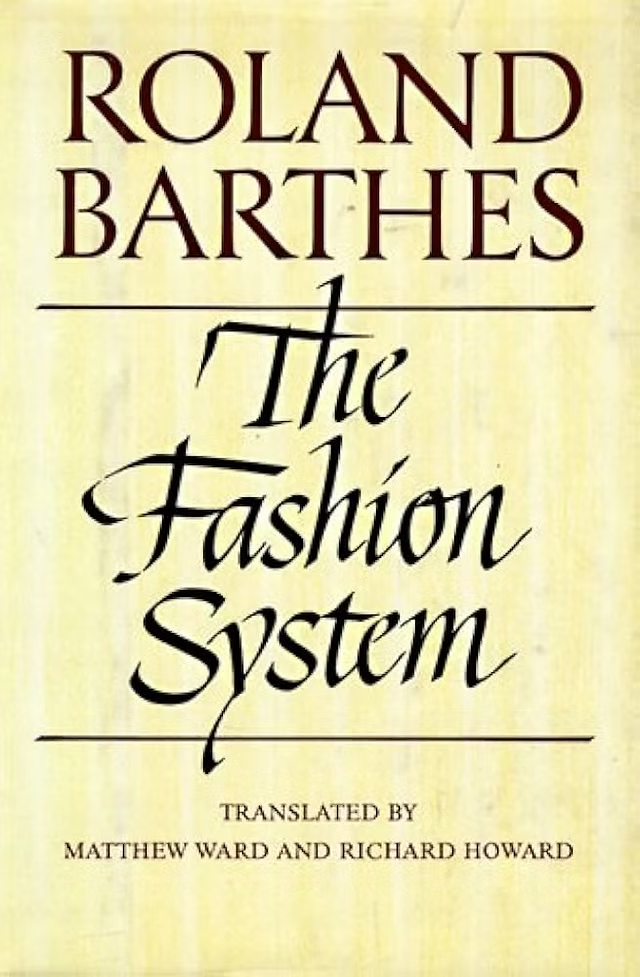
The Fashion System — Roland Barthes (1967)
This is the most intellectually demanding book on this list and also, arguably, the most foundational. Roland Barthes , the French literary critic and philosopher who wrote about everything from professional wrestling to the Eiffel Tower through the lens of semiotics ,spent years in the late 1950s and early 1960s analysing a single year of French fashion magazines, examining not the clothes themselves but the language used to describe them. His conclusion, developed across hundreds of dense, rigorous pages, is that fashion is a sign system , a language with its own grammar, syntax and rules , and that understanding how it communicates requires the same kind of close reading we apply to any other text.
It is not an easy read. Barthes was not writing for a general audience, and the theoretical framework he employs assumes a certain familiarity with structural linguistics. But fashion critics, fashion journalists and fashion educators have been returning to it for sixty years because the questions it asks , what does fashion mean, how does it mean it, who decides , are the questions that underlie everything else. Even if you read it slowly and partially, it will change the way you look at a fashion magazine.
Fashionopolis: The Price of Fast Fashion and the Future of Clothes — Dana Thomas (2019)
Dana Thomas appears on this list three times, which is not a coincidence. She is one of the most rigorous and readable fashion journalists working anywhere, and Fashionopolis is her most ambitious book — a global investigation into the fashion industry’s environmental and social impact, balanced with an equally thorough investigation of the people and technologies working to change it.
Where Overdressed focuses on the consumer side of fast fashion, Fashionopolis goes deeper into the supply chain , the factories, the chemistry, the labour conditions, the water consumption, the waste. Thomas travelled the world to report this book, visiting garment factories in Bangladesh, textile innovators in California, sustainable farms in Texas and technology startups in Europe. The result is the most complete picture available of where fashion comes from, what it costs, and what a genuinely sustainable alternative might look like. Given that the fashion industry is now estimated to be responsible for somewhere between 8 and 10 percent of global carbon emissions, this is not a niche interest. It is one of the most important books about the industry that exists.
The Little Dictionary of Fashion — Christian Dior (1954)
And then there is this. A small book. Slender enough to fit in a coat pocket. Written by the man who reinvented women’s dressing in 1947 with the New Look and who spent the decade that followed being one of the most influential creative minds in the history of the industry.
The Little Dictionary of Fashion is not a history book or an investigation or a theoretical text. It is Dior himself, in his own voice, writing alphabetically about the things he believed mattered in dressing , elegance, simplicity, colour, fabric, accessories, the relationship between a woman and her clothes. Some of what he writes is specific to his time. Much of it is not. “Simplicity is the keynote of all true elegance” , a sentence from a book published in 1954 , is either a cliché or a profound truth, depending on how seriously you have thought about the question. Dior thought about it seriously. And reading this book, you understand not just what he thought but how he thought, and why those two things were what made his clothes different from anyone else’s.
It is also, incidentally, a beautiful object. The kind of book you find in a second-hand shop and immediately understand why someone kept it for seventy years.
All images featured in this article are credited to owners . They are used for editorial and illustrative purposes only, with no commercial intent. All rights remain with their respective owners.