 111
 2
 3
 4
 5
 6
 7
 8
In keeping with the dark romanticism of Friday the 13th, we analyse the architectural and sartorial genius of genre cinema. Going far beyond theatrical characterisation, the visionary costume designers behind these 11 cinematic worlds transformed the screen into a testing ground for anatomical, textile and conceptual experimentation, forever altering the catwalks of Alexander McQueen, Christian Dior, Givenchy and Balenciaga.
Under the direction of Francis Ford Coppola, Japanese costume designer Eiko Ishioka, who earned an Academy Award for her work on the film, rejected the tired tropes of Universal horror. In place of Victorian black velvet capes, Ishioka conceived a textile mythology grounded in symbolism, immortality, and psychological decay.
The film’s most disturbing sartorial achievement is the crimson armor worn by Vlad Tepes (Gary Oldman). Cast in molded leather with an exoskeleton silhouette inspired by armadillo plating and exposed human musculature, the suit conveys a visceral, sacerdotal ferocity. Ishioka juxtaposed this biological violence with Klimt-esque gold-embroidered silk robes and the ethereal wedding gown of Lucy Westenra (Sadie Frost), characterized by an exaggerated, stiff circular lace ruff that transformed the victim into a pristine, sacrificial vessel.
Michael Kaplan and Charles Knode’s BAFTA-winning costume design for Ridley Scott’s dystopian masterpiece established the visual lexicon of cyberpunk, grafting 1940s film noir tailoring onto a decaying, rain-slicked futuristic metropolis.
Rachael’s (Sean Young) wardrobe stands as an unquestioned monument in cinematic fashion. Her iconic charcoal suit features exaggerated, origami-folded geometric shoulder pads that echo Adrian’s 1930s tailoring for Joan Crawford, reinterpreted through crisp Japanese textile geometry. Paired with an oversized fur-collared trench coat that frames her porcelain features, Rachael established the archetype of the android femme fatale.
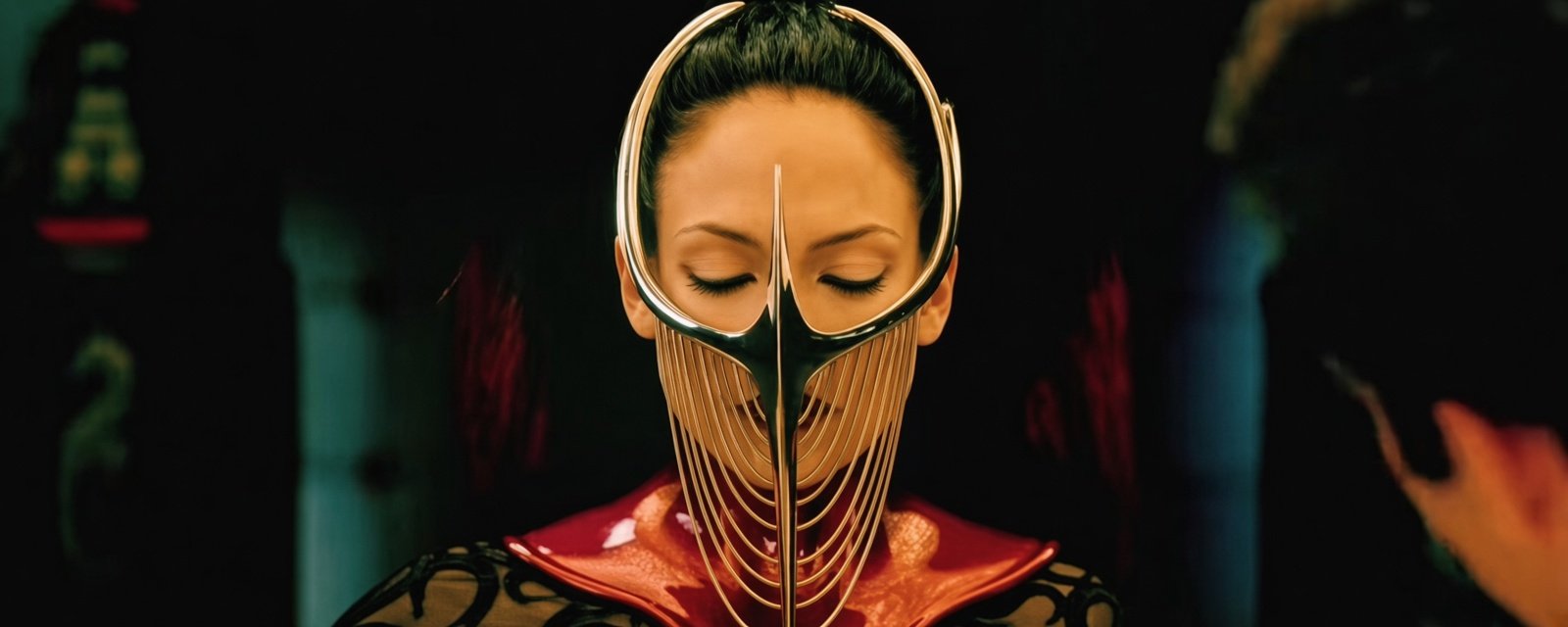
Reuniting with director Tarsem Singh, Eiko Ishioka ventured into the subconscious mind of a serial killer, constructing an unsettling visual landscape where high fashion meets psychological torture.
The psychic immersion suit worn by Jennifer Lopez features a rigid, high-standing vinyl collar designed to restrict movement, symbolizing emotional vulnerability. In the subconscious throne room sequences, Ishioka crafted the “Star Maiden” gown—a staggering feat of wearable sculpture featuring a transparent acrylic neck collar and rigid, heavy drapes that immobilized the actress. The costume transcended narrative function to become a piece of museum-grade performance art.
Oscar-winning designer Sandy Powell approached Anne Rice’s vampire chronicle with historical rigor and decadent decay. Tailored in the historic ateliers of Tirelli Costumi in Rome, the wardrobe traces the two-century evolution of Lestat de Lioncourt (Tom Cruise) and Louis de Pointe du Lac (Brad Pitt).
Powell utilized weathered jewel-toned velvets, deep emerald, crushed sapphire, and burnt burgundy—accented with hand-made lace jabots and tarnished gold thread embroidery. By aging the opulent 18th-century frock coats, Powell captured the tragedy of eternal life: garments that remain intoxicatingly luxurious while showing the slow erosion of time.
Luc Besson enlisted fashion’s enfant terrible, Jean Paul Gaultier, to design over 1,000 costumes for his futuristic space opera. Gaultier brought his signature irony, erotism, and Parisian tailoring mastery to every frame.
Leeloo’s (Milla Jovovich) white thermal bandage suit, constructed from minimal elastic straps referencing bondage aesthetics, became an instant pop-culture artifact. Equally iconic was Ruby Rhod’s (Chris Tucker) leopard-print velvet jumpsuit featuring a sculpted heart-shaped rose neckline, alongside neon-blue galactic flight attendant uniforms that demonstrated how French haute couture could redefine sci-fi costume design.
Working with a modest budget, costume designer Kym Barrett translated the Wachowskis’ digital universe into a masterclass of industrial minimalism, prioritizing movement and light reflection over costly luxury textiles.
Neo’s (Keanu Reeves) flowing coat was crafted not from heavy wool, but from an inexpensive $3-a-yard synthetic nylon blend that billowed weightlessly during martial arts sequences. Trinity’s (Carrie-Anne Moss) form-fitting PVC trench coat and micro-oval sunglasses redefined slick, fetishistic cyber-armor.
Directed by Tony Scott, The Hunger remains the most sartorially sophisticated vampire film ever made. Four-time Oscar winner Milena Canonero collaborated directly with the house of Yves Saint Laurent to dress Catherine Deneuve as the immortal Miriam Blaylock.
Deneuve wore bespoke Yves Saint Laurent Haute Couture: sharp-shouldered 1980s tailoring infused with 1930s veil-and-pillbox-hat elegance, severe leather pencil skirts, and cat-eye sunglasses, paired with custom footwear by Manolo Blahnik.
Based on Jean-Claude Forest’s French comic strip, Barbarella captured the 1960s Space Race obsession. While Jacques Fonteray handled general costume production, Spanish master Paco Rabanne was brought in to forge the futuristic armor for Jane Fonda.
Rabanne utilized his signature articulated green plastic tiles, aluminum mail, and flexible vinyl to sculpt a futuristic heroine silhouette. The costumes discarded traditional woven textiles entirely, establishing an aesthetic where industrial design meets seductive couture.
In Luca Guadagnino’s cold, oppressive reimagining of Dario Argento’s classic, costume designer Giulia Piersanti abandoned bright Dario Argento primary colors in favor of a muted, sinister 1977 Berlin palette.
The climax of Piersanti’s work appears in the “Volk” dance performance. The costumes were crafted entirely from hand-braided red silk ropes, engineered to mimic human arteries, muscle fibers, and anatomical ligatures. As the dancers move, the ropes whip and bind the body, turning choreography into a bloody, visceral ritual.
Oscar-winning designer John Mollo created a realistic, blue-collar aesthetic for Ridley Scott’s space thriller, establishing the concept of “used universe” workwear.
Ellen Ripley’s (Sigourney Weaver) heavy olive-drab flight suit, equipped with functional webbing, lacing, Nostromo shoulder patches, and paired with custom white leather Reebok Alien Stomper high-tops, forged the archetype of the practical female action hero.
For Queen Padmé Amidala (Natalie Portman), costume designer Trisha Biggar executed one of the most intricate costume productions in film history, pulling from global royal archives.
The Royal Senate gown features a crimson silk robe embroidered with gold thread, an illuminated lower hem, and a structural headpiece inspired by Mongolian royalty and Qing dynasty court dress. The architectural armatures required to support the weight transformed Amidala into an untouchable imperial icon.
| Film Title | Year | Costume Designer | Key Silhouette / Piece | Primary Materials | Runway Impact / Legacy |
|---|---|---|---|---|---|
| Bram Stoker’s Dracula | 1992 | Eiko Ishioka | Muscle armor / Klimt gold cape | Molded leather, gold silk, lace | Alexander McQueen, Dior (Galliano) |
| Blade Runner | 1982 | Michael Kaplan & C. Knode | Origami 1940s padded suit | Structured wool, fur, silk | Givenchy (McQueen), Raf Simons |
| The Cell | 2000 | Eiko Ishioka | Red vinyl suit / Acrylic collar | Latex, PVC, clear acrylic | Iris van Herpen, Comme des Garçons |
| Interview with the Vampire | 1994 | Sandy Powell | Weathered Rococo frock coat | Aged jewel velvet, lace, gold thread | Ann Demeulemeester, Hedi Slimane |
| The Fifth Element | 1997 | Jean Paul Gaultier | Elastic thermal bandage suit | White elastic straps, leopard velvet | Jeremy Scott, Marine Serre, Mugler |
| The Matrix | 1999 | Kym Barrett | Full-length sweeping trench | $3/yd nylon knit, PVC, vinyl | Dior Homme (Slimane), Balenciaga |
| The Hunger | 1983 | Milena Canonero & YSL | Sharp 80s-meets-30s YSL suit | Wool tailoring, leather, mesh veils | McQueen SS96 (“The Hunger”) |
| Barbarella | 1968 | Paco Rabanne & J. Fonteray | Tile armor / Metallic link mail | Rhodoid plastic, aluminum, vinyl | Thierry Mugler, Balmain |
| Suspiria | 2018 | Giulia Piersanti | “Volk” arterial rope dress | Hand-braided red silk cordage | Rick Owens, Craig Green |
| Alien | 1979 | John Mollo | Flight suit & Alien Stompers | Heavy lona canvas, leather | Helmut Lang, Alyx, Balenciaga |
| Star Wars: Ep. I | 1999 | Trisha Biggar | Royal Senate illuminated gown | Crimson silk, gold wire, metal frame | Dior Couture, McQueen FW08 |
All images featured in this article are credited to owners . They are used for editorial and illustrative purposes only, with no commercial intent. All rights remain with their respective owners.