Fashion has always had a soundtrack.
Sometimes it comes from the runway. Sometimes from the club. Sometimes from the dressing room, when a song becomes part of the ritual of getting ready.
But every once in a while, fashion makes it directly into the lyrics.
A designer becomes a status symbol. A handbag becomes a character. A pair of shoes becomes shorthand for confidence. A fashion house becomes part of a fantasy.
And suddenly, a luxury brand isn’t just something you wear.
It becomes part of pop culture.
From Bruno Mars putting Versace on the floor to A$AP Rocky turning an entire wardrobe into a rhyme scheme, these are 20 songs that understood the relationship between music and fashion particularly well.
Not simply songs that mention expensive things.
Songs where luxury became part of the story.
01. Bruno Mars — “Versace on the Floor”
Let’s start with the obvious one.
Bruno Mars didn’t simply mention Versace. He built an entire romantic fantasy around the Italian house.
Released in 2016, the song turns Versace into an atmosphere: glamorous, intimate and deliberately excessive. The title itself became one of the clearest examples of a fashion house becoming part of a pop song’s visual identity. Even the music video reinforces the relationship between Bruno’s retro-romantic aesthetic and the glamour associated with the brand.
It is difficult to think of another song where a luxury label feels quite so naturally woven into the fantasy.
Fashion mood: old-school glamour, champagne, silk and very expensive bad decisions.
02. JAY-Z — “Tom Ford”
JAY-Z has never been shy about treating fashion as a language of power.
“Tom Ford”, released on Magna Carta Holy Grail in 2013, takes the designer’s name and turns it into the centre of a rap statement.
What makes it particularly interesting is that Tom Ford himself embraced the song and its cultural impact. The track became one of those rare moments when a fashion designer’s name moved effortlessly from the runway into mainstream hip-hop vocabulary.
JAY-Z wasn’t simply talking about clothes.
He was talking about what the clothes represented.
Fashion mood: black tailoring, private jets and absolutely no need to explain yourself.
03. Frank Ocean — “Chanel”
Frank Ocean’s “Chanel” is perhaps the most sophisticated song on this list because the brand isn’t simply functioning as a luxury flex.
The song uses Chanel as a cultural symbol while playing with ideas of duality and identity. Even the famous double-sided imagery associated with the song makes the reference feel more conceptual than commercial.
Chanel becomes an idea.
Not just a logo.
Fashion mood: Paris at midnight, black sunglasses and something deliberately ambiguous.
04. Tyla — “CHANEL”
Almost a decade after Frank Ocean’s track, Tyla gave the name a completely different energy.
Her 2025 single “CHANEL” turns the French house into part of a contemporary, sensual pop language. The song was released in October 2025 through Epic Records and quickly became another example of a luxury name being transformed into a pop-cultural hook.
The contrast with Frank Ocean is fascinating.
Same house. Completely different universe. And that’s precisely why Chanel works so well in music: it can mean elegance, seduction, wealth, rebellion or simply I know exactly what I’m wearing.
Fashion mood: glossy skin, late-night driving and a tiny black dress.
05. Pop Smoke — “Dior”
Pop Smoke’s “Dior” is one of the strongest examples of a fashion name becoming something much bigger than fashion.
Released in 2019, the Brooklyn drill anthem became inseparable from Pop Smoke’s identity and, following his death in 2020, took on an even larger cultural significance. Dazed describes it as both a New York drill anthem and one of his most enduring songs.
Dior isn’t presented as delicate Parisian luxury here. It becomes street language.
That transformation is important.
Luxury doesn’t always have to remain inside the world it was created for.
Sometimes the street takes it somewhere else.
Fashion mood: Dior with a bass-heavy soundtrack.
06. Lady Gaga — “Donatella”
Nobody was going to make a list like this without Gaga.
“Donatella”, from 2013’s ARTPOP, takes the mythology surrounding Donatella Versace and turns it into a larger-than-life pop character. The lyrics move through fashion, wealth, beauty and the performance of being fabulously excessive, while Versace is central to the song’s imagery.
It feels less like an endorsement than a fashion illustration.
And that is very Gaga.
Fashion mood: platinum hair, skyscraper heels and arriving deliberately overdressed.
07. A$AP Rocky — “Fashion Killa”
If there is one song that deserves to be taught in a fashion-school playlist, it might be this one.
“Fashion Killa” is practically a designer roll call, with references stretching from Prada, Dolce & Gabbana and Balenciaga to Helmut Lang, Alexander Wang, Donna Karan, Cartier and Jean Paul Gaultier. British Vogue has described the track as naming an extraordinary range of designers, while Fashionista noted that the original song referenced 27 designers.
But the genius isn’t simply the number of names.
Rocky treats fashion knowledge itself as part of his identity.
Knowing the designer is part of the flex.
And that distinction changed the way hip-hop could talk about fashion.
Fashion mood: the coolest person in the room knows exactly who designed your jacket.
08. A$AP Mob — “RAF”
If “Fashion Killa” celebrated fashion broadly, “RAF” went considerably deeper.
The 2017 A$AP Mob track is essentially an homage to Belgian designer Raf Simons, with A$AP Rocky, Playboi Carti, Quavo, Lil Uzi Vert and Frank Ocean turning the designer’s name into a cultural reference.
That matters because Raf Simons was never simply a mass-market luxury name.
He represented fashion credibility.
The song helped demonstrate that avant-garde designers could become part of mainstream musical vocabulary.
Fashion mood: Antwerp meets Harlem.
09. Rosalía & Tokischa — “LA COMBI VERSACE”
Few songs understand the pleasure of dressing up quite like this one.
Released as part of Rosalía’s MOTOMAMI era, “LA COMBI VERSACE” turns Versace into a full visual fantasy. The matching outfits are part of the point.
It’s not quiet luxury. It’s not restrained. It’s Versace as attitude.
The track’s importance also lies in the way it connects European luxury with contemporary Latin music without making either side feel secondary.
Fashion mood: gold jewellery, tiny sunglasses and absolutely no neutral colours.
10. Migos — “Versace”
Before Versace became one of the most familiar luxury names in contemporary rap, Migos made the brand part of their own musical mythology.
“Versace”, released in 2013, became one of the group’s breakthrough records and helped establish the repetitive, instantly recognisable luxury-brand hook that would become a familiar device throughout hip-hop.
The song is almost deliberately excessive.
And that’s why it works.
Versace is repeated until the name stops sounding like a brand and starts sounding like a lifestyle.
Fashion mood: maximalism with the volume turned all the way up.
11. Kreayshawn — “Gucci Gucci”
“Gucci Gucci” arrived in 2011 and became a defining moment of internet-era pop rap.
It was catchy, irreverent and built around the cultural power of the Gucci name. The song reached No. 57 on the Billboard Hot 100 and was eventually certified gold in the United States.
But there was something clever underneath the playful repetition.
Kreayshawn wasn’t simply celebrating luxury.
She was playing with the idea of fashion tribes and what it meant to look expensive.
Fashion mood: Tumblr-era cool, sunglasses indoors and shopping with an attitude.
12. Lil Pump — “Gucci Gang”
Then came the song that turned a luxury house into a meme.
“Gucci Gang” is almost absurdly repetitive, but that was precisely its cultural power.
The phrase became bigger than the song itself, transforming Gucci into shorthand for a particular internet-rap aesthetic.
Dazed included it among its essential fashion-brand songs, and its inclusion makes sense: few tracks have demonstrated quite so clearly how a luxury name can become part of youth slang.
It may not be subtle.
It was never supposed to be.
Fashion mood: neon, designer logos and absolutely zero subtlety.
13. Arca — “Prada”
This is where the list gets more interesting.
Arca’s “Prada” doesn’t treat the Italian house in the same way as a traditional hip-hop flex.
The track feels darker, stranger and more nocturnal.
The Prada reference becomes part of Arca’s futuristic, experimental world rather than simply functioning as proof of wealth. Dazed highlighted the song for precisely that collision between Prada’s fashion language and Arca’s after-dark electronic universe.
It’s fashion as atmosphere.
Fashion mood: Prada after midnight, somewhere you probably shouldn’t be.
14. PnB Rock feat. Nicki Minaj & Murda Beatz — “Fendi”
Some songs mention a brand.
This one simply gives the brand the title.
“Fendi” arrived in 2019 with Nicki Minaj and Murda Beatz joining PnB Rock, and the track makes the Italian house part of a contemporary hip-hop fantasy of style, attraction and excess.
It is also a reminder that fashion references aren’t exclusively about the clothes themselves.
Luxury brands become shorthand for a certain kind of person.
A certain lifestyle.
A certain fantasy.
Fashion mood: Fendi boots, fast cars and a very expensive night out.
15. Jennifer Lopez — “Louboutins”
Before the red sole became one of the most instantly recognisable symbols in footwear, Christian Louboutin had already become a pop-cultural shorthand for glamour.
Jennifer Lopez’s “Louboutins” took the designer’s name and turned it into the centre of a song about confidence and leaving a bad relationship behind. The track was released in 2009 and was explicitly built around the Louboutin reference.
It’s a particularly fun example because the shoes aren’t simply decoration.
They’re armour.
Fashion mood: red soles, revenge dressing and walking away beautifully.
16. Kanye West — “Christian Dior Denim Flow”
The title alone tells you exactly where Kanye’s priorities were.
“Christian Dior Denim Flow” takes the name of one of fashion’s most influential houses and places it directly into the title of a track packed with fashion imagery.
It’s an early example of Kanye treating fashion not as an accessory to music but as part of the same creative territory.
For him, music and fashion were never really separate industries.
They were two sides of the same cultural language. The song is also regularly cited among notable fashion-brand tracks.
Fashion mood: Dior denim, sunglasses and creative-director energy.
17. Fergie — “Labels or Love”
What happens when fashion becomes more attractive than romance?
Fergie answered the question in 2006.
“Labels or Love”, famously associated with Sex and the City, turns designer names into the central conflict of the song. Manolo Blahnik, Louis Vuitton, Dior, Gucci, Fendi, Prada and Cartier all enter the conversation.
It’s almost a fashion editorial disguised as a pop song.
And honestly?
Carrie Bradshaw would probably approve.
Fashion mood: Manhattan, a credit card with questionable limits and shoes that deserve their own apartment.
18. Drake feat. T.I. & Swizz Beatz — “Fancy”
“Fancy” is a particularly good example of how luxury fashion became part of the language of 2000s hip-hop.
The song name-checks Alexander McQueen, Prada, Gucci, Chanel, Dolce & Gabbana, Versace and Louis Vuitton among others.
But what makes the track memorable is the way those names are used to construct a character.
The woman isn’t simply wealthy.
She’s fancy.
Fashion becomes personality.
Fashion mood: perfect hair, perfect nails and an extremely organised handbag.
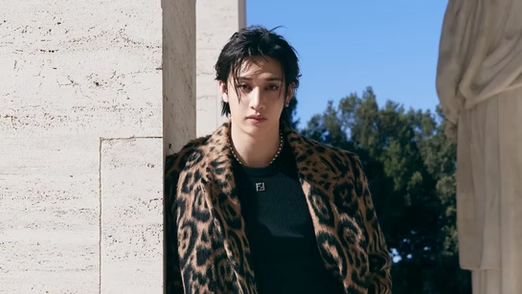
19. Bang Chan — “Roman Empire”
Luxury and music have always had a complicated relationship.
But every so often, a collaboration feels less like a brand placement and more like two creative worlds genuinely meeting.
“Roman Empire” is one of those moments.
Released by Bang Chan as part of his solo work, the track was created in connection with Fendi, the Italian luxury house with which he has developed a strong relationship as a global ambassador.
And that context changes the way you hear the song.
This isn’t simply an artist dropping a designer name into a verse.
The fashion house is part of the creative universe surrounding the track.
Fendi’s influence is present in the visual identity, the styling and the wider campaign, creating the kind of connection between music and fashion that luxury brands increasingly seek from today’s global ambassadors.
Bang Chan is particularly interesting in this space because his relationship with Fendi sits at the intersection of several different worlds: K-pop, music production, performance, personal style and international luxury.
The result feels less like traditional celebrity endorsement and more like a conversation between artist and maison.
And that is exactly where luxury fashion has been heading.
The most successful collaborations no longer ask an artist simply to wear the clothes.
They ask them to become part of the story.
Fashion mood: Fendi tailoring, Roman grandeur, dark glamour and a soundtrack made for walking into the room knowing everyone is looking.
Why it belongs on this list
“Roman Empire” deserves its place here for a slightly different reason than the other songs.
Most of the tracks on this list use luxury brands as lyrical shorthand: wealth, desire, status, aspiration or identity.
“Roman Empire” represents the next stage.
The relationship between music and fashion is no longer limited to a lyric mentioning a label.
The artist can become an extension of the house’s cultural identity.
That is particularly relevant in the Korean entertainment industry, where global ambassadors are increasingly expected to bring their own creative universe to luxury rather than simply appearing in a campaign. Bang Chan and Fendi are a good example of that evolution.
The fashion house gets access to his enormous global audience. The artist gets to explore another creative dimension. And the audience gets something more interesting than an advertisement.
A piece of music with a fashion world attached to it.
Sometimes the most powerful fashion reference isn’t a name hidden inside a lyric and the entire song becomes part of the brand story.
20. Ariana Grande — “7 rings”
And finally, Tiffany.
Ariana Grande’s “7 rings” isn’t technically a fashion-house anthem, but leaving it out would feel wrong.
The song builds its fantasy around jewellery, shopping and luxury consumption, opening with the now-famous reference to Tiffany’s and turning retail therapy into a declaration of independence.
What makes the song particularly interesting is that the luxury isn’t presented as something a man has bought for her.
She buys it herself.
The luxury fantasy becomes female agency.
And that makes “7 rings” one of the clearest examples of how the meaning of fashion references in pop music has changed.
Fashion mood: diamonds, pink champagne and buying your own fantasy.