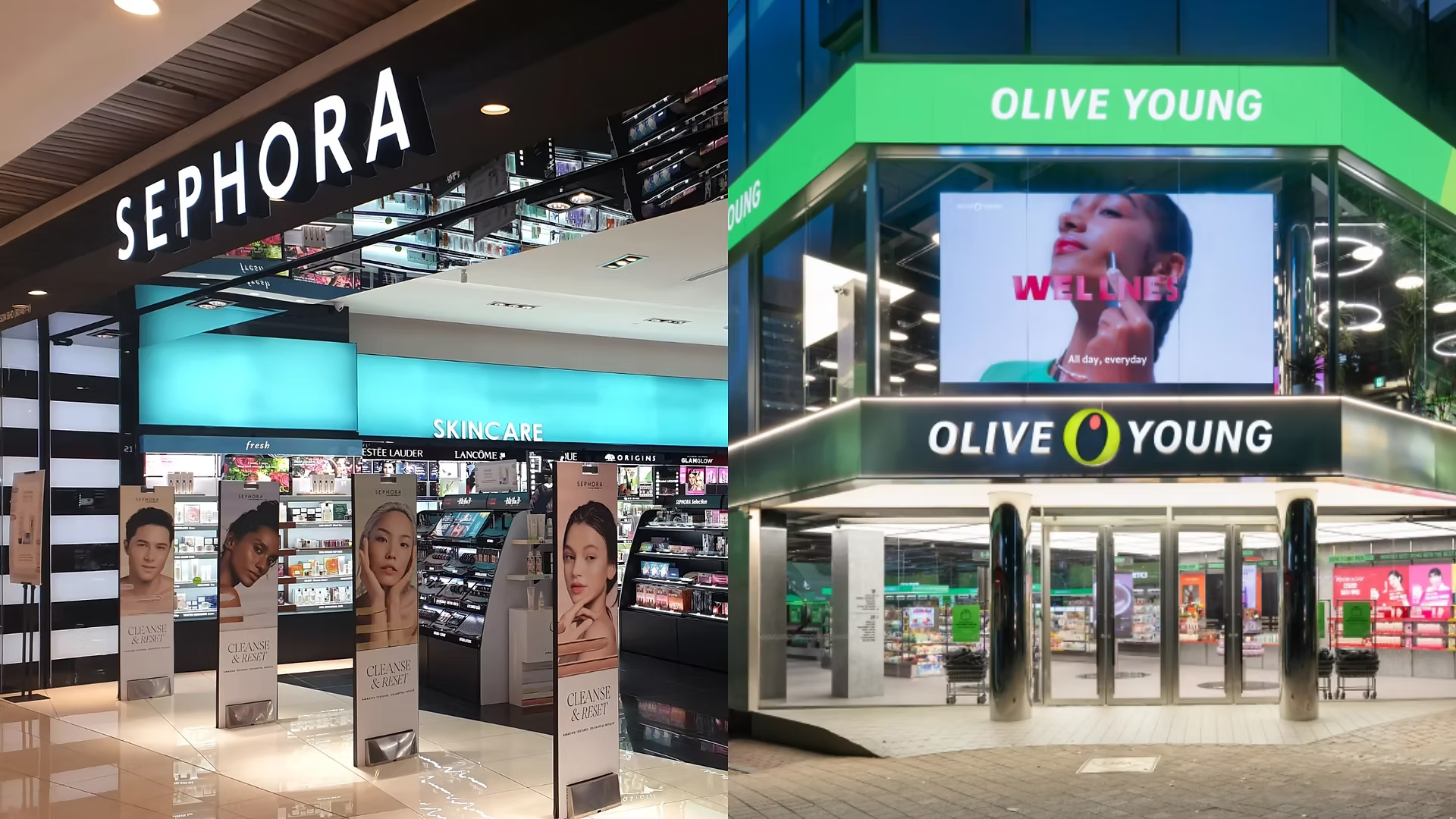
Glass skin or effortless glow , the world’s two most influential beauty cultures are more similar than they’d like to admit.
There is a moment that happens in the skincare aisle , in Sephora, in a Paris pharmacy, in an Olive Young in Seoul , where you stand in front of two completely different worlds and have to choose. On one side: a single bottle of micellar water, a moisturiser, maybe a serum. On the other: twelve products, each one more precisely targeted than the last, each one promising to address something specific about your skin that you weren’t even aware was wrong.
This is the essential tension between French beauty and K-beauty. And it is, in 2026, one of the most commercially significant debates in the global cosmetics industry , with a market that has grown from a regional phenomenon into a $17 billion global force, projected to reach $34 billion by 2033. Two philosophies. Two cultural identities. One shared obsession: healthy, luminous, beautiful skin.
THE PHILOSOPHY BEHIND THE ROUTINE
Before you can understand the products, you have to understand what each culture actually believes about skin , and about beauty itself.
The French approach starts from a premise of acceptance. The skin is something to be maintained, protected, and enhanced , not transformed. French beauty, rooted in the pharmacy culture of La Roche-Posay, Avène, and Vichy, is built around the idea that your skin already knows what it needs. Your job is to support it, not to fight it. This is the philosophy that produces the famously minimal French routine: cleanse, tone if necessary, treat, moisturise, SPF. Five steps, maximum. Multi-functional products preferred. Elegance through restraint.
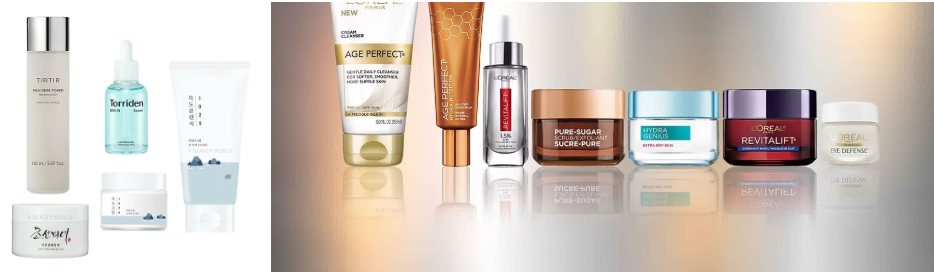
The Korean approach starts from a fundamentally different premise. Skin is not something to be accepted as-is , it is something to be actively cultivated, layered, and improved. K-beauty is the skincare equivalent of a serious training regime: consistent, disciplined, targeted, and built on the understanding that every step serves a different function. The famous ten-step routine , double cleanse, toner, essence, serum or ampoule, sheet mask, eye cream, moisturiser, sleeping mask, SPF , is not excess. It is architecture. Each layer is thin, lightweight, and designed to work with the layers above and below it.
The difference, at its most philosophical, is this: French skincare asks what your skin needs to stay healthy. Korean skincare asks what your skin could look like if you gave it everything it needs to be its best.
THE INGREDIENTS THAT DEFINE EACH WORLD
The gap between the two philosophies is nowhere more visible than in the ingredient lists.
French skincare, with its roots in dermatological research and pharmacy culture, favours clinically tested actives: retinol for anti-ageing, niacinamide for brightening, vitamin C for radiance, hyaluronic acid for hydration. These are ingredients with decades of peer-reviewed evidence behind them. French brands move slowly and deliberately. The innovation cycle is measured in years, not months. A La Roche-Posay product earns trust through rigorous testing and dermatologist endorsement, not through viral TikTok moments.
K-beauty, on the other hand, has built one of the most agile and innovative ingredient ecosystems in global cosmetics. Where French skincare favours the established, K-beauty celebrates the unexpected. Snail mucin , the secretion of the common garden snail, rich in glycoproteins and hyaluronic acid , became a global bestseller through COSRX, whose Advanced Snail 96 Mucin Power Essence achieved such commercial success that the brand was eventually acquired by Amorepacific, Korea’s largest beauty conglomerate. Bee venom. Ginseng. Fermented rice water. Centella asiatica. Propolis.
These are not gimmicks , they are the products of a beauty culture that has been experimenting with natural ingredients for centuries, now backed by cutting-edge Korean dermatological science.
The innovation cycle in K-beauty is extraordinarily fast. TirTir, one of the most talked-about brands of the past two years, expanded its Mask Fit Red Cushion foundation from a small shade range to forty shades in response to direct feedback from Black beauty influencers on social media , a pivot that landed the product at number one in Amazon’s foundation category, a position previously considered unreachable for a Korean brand in the American market. Beauty of Joseon, whose Relief Sun sunscreen became a word-of-mouth phenomenon in Europe and North America, reformulated traditional Korean herbal ingredients , rice, ginseng, green plum , into modern, scientifically validated skincare that sits comfortably alongside French pharmacy staples in the same bathroom cabinet. Korean beauty exports surpassed $10 billion in 2025, positioning South Korea as a top global exporter alongside France and the United States.
THE ROUTINE: FIVE STEPS VS TWELVE
The most immediately visible difference between the two cultures is the length of the routine , and it is worth unpacking what that difference actually means.
The French three-to-five step routine is not laziness. It is efficiency. The French beauty consumer is not trying to fix their skin. They are maintaining it, the way you maintain a historic building , careful, consistent, attentive to what is already there. The products are chosen for quality over quantity. A single bottle of Bioderma Sensibio micellar water , one of the best-selling skincare products in France , cleanses and tones simultaneously, eliminating the need for two separate steps. The philosophy is: fewer, better products, used consistently over time.
The Korean six-to-twelve step routine is not indulgence. It is precision. Each product is formulated to be lightweight enough to layer without overloading the skin barrier , the first cleanser removes makeup and SPF, the second removes residual impurities, the toner balances pH, the essence provides the first layer of hydration, the serum or ampoule targets a specific concern, the sheet mask delivers an intensive treatment, the moisturiser seals everything in, the sleeping mask acts as an overnight barrier. The whole system is designed around the idea that thin layers of the right ingredients, applied in the right order, are more effective than a single heavy cream doing too many things at once.
THE CULTURAL CONTEXT: WHAT BEAUTY ACTUALLY MEANS
To understand why these two approaches exist, you have to understand what beauty means in each culture , because these are not just skincare routines. They are worldviews.
In France, beauty is intimately connected to the idea of naturalness and authenticity. The French cultural ideal is not perfection , it is individuality. A French woman is not trying to erase herself. She is expressing herself. The visible beauty standard in France includes the acceptance of fine lines, the tolerance of a slight imperfection, the refusal to be defined by age. French beauty at its most essential is the idea that confidence and self-assurance are themselves the most attractive things a person can wear — and that the right skincare is just the foundation that allows them to show up to their life without thinking about their face.
Korean beauty exists in a very different cultural conversation. South Korea has one of the most skin-focused beauty cultures in the world, and that focus is not simply about vanity , it is about care. Korean skincare routines begin young, often in early adolescence, with the understanding that consistent, gentle care over time is the most effective form of anti-ageing there is. The emphasis is on prevention rather than correction. On nourishment rather than intervention. On maintaining the integrity of the skin barrier so that everything else functions better. The Korean cultural relationship with skincare is less about appearance and more about discipline , the same discipline that shows up in Korean food culture, in Korean education, in the extraordinary global success of Korean entertainment. When you commit to something fully in Korean culture, you commit completely.
WHERE THE TWO WORLDS MEET
Here is the thing that the French pharmacy and the Seoul skincare counter have in common: they are both winning.
In January 2026, Sephora and CJ Olive Young , Korea’s largest health and beauty retailer , announced a strategic partnership to bring Korean beauty products to Sephora’s global customers, with dedicated Olive Young-curated zones in stores across the US, Canada, Hong Kong and Southeast Asia. French pharmacy brands like La Roche-Posay and Vichy have been expanding aggressively into Asian markets for years. L’Oréal, France’s global beauty giant, entered a definitive agreement in January 2025 to acquire Dr. G , a Korean dermatological skincare brand , specifically to strengthen its position in K-beauty. Estée Lauder owns Dr. Jart+. The conglomerates of French luxury beauty are buying into K-beauty because they know where the consumer is going.
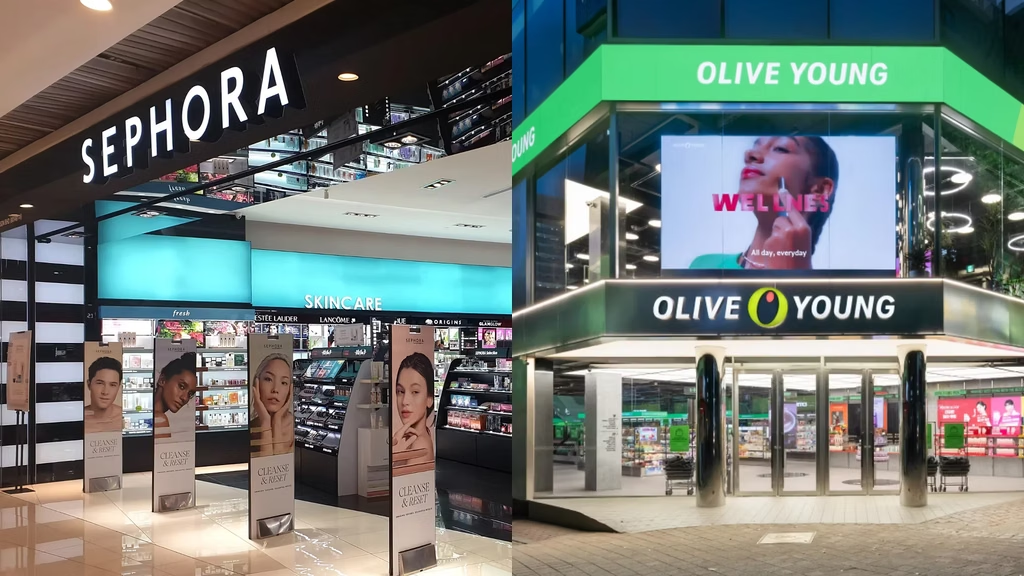
And where the consumer is going, increasingly, is toward a hybrid approach that borrows from both traditions. The double cleanse , oil-based cleanser followed by water-based cleanser, originally a cornerstone of Korean skincare , has now been adopted by millions of European and American consumers who had previously never thought beyond a single face wash. The sheet mask, once a distinctly Korean product, is now a standard offering in French pharmacies. Korean sunscreens, with their cosmetically elegant formulas and sophisticated chemical filter combinations, have found loyal audiences among French consumers who previously found European SPF formulations too heavy or too white-casting. Beauty of Joseon’s Relief Sun, which became so sought-after in France that online pharmacies and K-beauty specialist retailers ran out of stock repeatedly, represents this cross-pollination perfectly: a product built on centuries of Korean herbal tradition, formulated with Korean chemical engineering, embraced by French consumers who had spent decades trusting their local pharmacy.
Meanwhile, the K-beauty industry is increasingly moving toward the kind of long-term brand building and philosophy-led approach that has always defined the best of French beauty. As K-beauty expert Lauren Lee noted in late 2025, the brands that will survive into the next cycle are those that move from being purely product-led to being “clearly brand- and founder-led. They have a defined philosophy and point of view, are consistent about how they formulate and communicate, and they think about retention and lifetime value, instead of only chasing the next sold-out SKU on social media.” That sounds, remarkably, like a description of how the best French beauty brands have operated for decades.
THE FUTURE: ONE CABINET, TWO TRADITIONS
The conversation between K-beauty and French beauty is no longer about competition. It has become something more interesting , a dialogue between two traditions that are learning from each other in real time, each filling in the gaps the other has always had.
French beauty has the heritage, the clinical authority, and the cultural cachet. It has taught the world that skincare is about identity as much as efficacy, and that the most radical beauty statement you can make is to age on your own terms. K-beauty has the innovation engine, the ingredient curiosity, and the understanding that skincare is a daily practice rather than an occasional intervention. It has taught the world that taking your skin seriously is not vanity , it is self-respect.
In 2026, the most interesting skincare routines in the world borrow from both. The Bioderma micellar water next to the COSRX snail mucin. The La Roche-Posay SPF next to the Beauty of Joseon ginseng serum. The French philosophy of doing less, but doing it better, sitting alongside the Korean philosophy of doing more, but making every step count.
Two philosophies. Two cultures. One bathroom shelf. And, in the end, one goal: to look in the mirror and recognise yourself , healthy, luminous, and completely at ease in your own skin.
All images featured in this article are credited to owners . They are used for editorial and illustrative purposes only, with no commercial intent. All rights remain with their respective owners.